
John Judge
JOHN PATRICK JUDGE RIP December 14 1947 - April 15
2014
World peace
Can be achieved
When the powers of love
Replaces
The love of power.
- Sri Chinmoy
World peace
Can be achieved
When the powers of love
Replaces
The love of power.
- Sri Chinmoy
By Bill
Kelly
I met
John Judge in the fall of 1969 outside the University of Dayton Cafeteria at
the Kennedy Union where he was manning a table and passing out literature for
Conscious Objectors next to a US Marine Corps recruiting table. One of the
papers on his table was a copy of Jim Garrison’s interview in Playboy, which I
began to read and he told me to keep it, beginning our great life-long
adventure
together.
together.
When we
first met I was a freshman and he had just graduated, but he stuck around
campus as a political agitator just to rile the administration. My class was
the first freshman class that didn’t have mandatory ROTC for men, a requirement
that was lifted after Judge and others protested the forced military
commitment, and won. Judge apparently was required to take one year of ROTC,
though I
can’t imagine him in a military uniform.
can’t imagine him in a military uniform.
John
Judge was born in Washington DC on December 14, 1947. His father John Joseph Judge (of Scranton, Pa. May 17,
1913-December 27, 1965) and mother Marjorie Alice Cooley (of Springfield, Mo., Jan.
15, 1913 – April 26, 1978), were both civilian employees at the Pentagon.
Dayton, Ohio was a unique place to meet, and for awhile was once said to be the cosmic center of the universe. While
more liberal and less strict than, say, the Jesuits, the Marinasts had been
running a tight ship at Dayton since 1850, and they really do have ivy covered walls, and were
quite reluctant to change the way things were done. This was especially in the Engineering Research and Development, which received many millions of dollars
in research grants from the military, and Wright-Pat Air Force Base had a big
presence on campus.
Once
John got me interested in the assassination of President Kennedy, he took me
over to the UD library, the newest and largest building on campus, which housed
a complete copy of the Warren Commission volumes of testimony and exhibits,
which I began to read, taking special interest in the Cuban connections. The school library also had a subscription to an obscure magazine John called my attention to: Computers and Automation, which included articles about the Kennedy assassination and Watergate, some by researcher Richard A. Sprague.
It was
at Dayton when I first began to identify, locate and attempt to interview
witnesses. The first was Mrs. Margrete Hoover, of Martinsburgh, Pa., a small
town off the Pennsylvania Turnpike where Cuban exile Julio Fernandez had taken
up residence and taught Spanish at the local high school. Mrs. Hoover had
discovered some burnt trash that she suspected was from her estranged husband,
as she thought the names “Ruby” and “Lee Oswald” were women he was seeing, but
her daughter determined that the burnt trash had blown over from the neighbor’s
yard, where it was apparent Fernandez had been burning his trash and papers.
When
Mrs. Hoover told her brother that on the night of the assassination her
neighbor was awake all night and burning papers in his backyard – some of which
mentioned the names of “Ruby” and “Lee Oswald,” he notified the Pennsylvania
State Police who investigated, as did the FBI. Knocking on the door of the
neighbor, Julio Fernandez, admitted burning papers in his backyard, but denied
knowing Ruby or Oswald and proclaimed himself an anti-Communist patriot, one
who then quickly quit his job and disappeared from Martinsburg to an
undisclosed location.
I found
Mrs. Hoover’s name in the public phone directory and John Judge said we should
call her, so he took me over to the offices of the student body president in
Kennedy Union, where he said we could use the phone to make the long distance
and at the time, otherwise a prohibitively expensive phone call.
Mrs.
Hoover confirmed most of what was in the Warren Commission documents, and that
word on the streets of Martinsburg was that Fernandez had fled to Rye, New
York. And she also mentioned that I wasn’t the only person still interested in
the incident and Fernandez – two men in black suits came by knocking on her
door asking about it.
One of
John’s radical and revolutionary friends – Kevin Keefe – was a six-foot-six
Ichabod Crain type character who was elected student body president. Kevin went
around campus in bare feet and a robe, like Jesus Christ, and used his office
to bring in a series of special guests – Paul Krasner, the editor and publisher
of the satirical Realist magazine, radical educationalist Michael Hoffman and
at the urging of Judge – Mae Brussel, who brought up the assassination of
President Kennedy as a subject worthy of our interest.
After
Mae’s well attended lecture, I assisted by carrying her bag of books to the
parking lot, about a block away. Once there, we were approached by a man who
called out to Mae and sheepishly said hello, and then asking Mae, “Don’t you
know who I am?”
Under
the street light in the parking lot Mae looked and squinted and said, “You look
like Lee Harvey Oswald.”
“A lot
of people say that,” the guy responded. “I’m Don Norton.”
“Oh,
Don!” Mae said, “thank you so much for your letters and support. I put your
money to good use.”
“That’s
my conscience money,” Norton said.
John
then invited Norton to accompany us back to his house where Mae was spending
the night, and since I was a young, seventeen year old college freshman with a
heavy date on the other side of campus, I left them at the parking lot while
they went back to John’s living room to talk some more.
While I
now wish I had accompanied them, I did find out a lot more about Don Norton,
and the fact that there are two Don Nortons – Don P. Norton and Don O. Norton,
and then yet another Don Norton who wrote a defense industry history. Don O.
Norton was a supposed Oswald look-a-like and East Coast fisherman, while Don P.
Norton was a homosexual piano playing private at a officers club when he was
recruited by military intelligence to report on gay military officers. Don P.
Norton said he met the real Oswald in Mexico and obtained documents and money
from him that he delivered to Canada. He later became a subject in the Garrison
investigation.
[John
Judge on Don Norton:
John
Judge also had me accompany him to nearby Yellow Springs, Ohio, home of Antioch
College, Glen Helen park, Ruth Paine’s brother, Dr. Paine and a documented
Oswald sighting investigated by the Dayton Police intelligence squad.
Founded
by Horace Mann - the Father of American Education, Antioch was a rural, radical
college that was light years ahead of education reform at the time – no grades,
co-ed dorms, important internships and a non-violent Quaker-like tradition
whose graduates include the Twilight Zone’s Rod Serling, Mrs. Martin Luther
King, Jr. and Ruth Hyde Paine, whose brother lives in Yellow Springs today.
John
took me to Antioch for a nighttime seminar being given on the history of Vietnam
by a recently returned CIA station chief – or so he was described, and it was a
fascinating lecture, as he explained that this was a nationalistic revolution
not a communist one, and that we had backed the wrong regime – we had trained
and educated Ho Chi Min and when he asked for it, we should have supported him
rather than the corrupt Catholic Diems. I later attended graduate school at the
Antioch College Baltimore satellite campus – Center for Strategic Policy and
Action, where we were once again lectured by former CIA officers and analysts.
But in 1970 I didn’t know any of this and was just a confused teenager, eyes
wide open, who was being led around by John Judge.
A few
years later, in the spring of 1972, school was out except for a few special programs,
so John and I were pretty much alone in the cafeteria eating lunch when John
looked up from his newspaper and said, “Get a load of this!”
He then
began reading the short, one column three inch news report on the Watergate
burglary.
“These
are the same guys who killed Kennedy!” John said on the spot.
Back to
the library where before the day was out we had put together good profiles of
the Watergate burglars, and called Mae, probably from Kevin Keefe’s office.
While
Keven Keefe was long gone, John Judge’s Dayton sweetheart Kathe was also
politically active and was elected student body president, possibly the first
women to do so. After graduation Kathy moved to New York City where she lived
in an apartment overlooking Central Park and across the street from the Dakota,
where John Lennon was killed. Kathe saw Lennon moments before he was shot, was
an ear witness to the murder and was an important source for the cover-story
news article I wrote for the Atlantic City Sun the next day. Even after they
broke up, John and Kathy stayed close and John visited her every Thanksgiving
and Christmas holiday for many years.
At some
point, I don’t even remember if it was in the late 70s, John took me to my
first JFK conference at the NYU Law School where we met with Mae, and John
introduced me to Penn Jones, the scrappy editor and publisher of the
Midlothian, Texas Mirror news. We also hooked up with Kevin Keefe, who was now
an assistant to Sri Chinmoy, the spiritual advisor to the United Nations. “It’s
going to be a good year for all of us,” Kevin said optimistically. Actually
Kevin says that every time I see him, sometimes decades apart.
Walking
around the NYU law school class rooms I sat in on one lecture by Fletcher
Prouty, who was making chalk diagrams on a blackboard on the nature of covert
operations – how and why they work, how there are multi-levels of connections
and communications and how they are designed to protect the identity of their
actual sponsors.
Near the
end a press conference was called where Ralph Schoeman held up copies of some
official FBI documents that he said proved conspiracy – records that tied one
of the Cubans arrested with Oswald in New Orleans to Teamster Union officials
in Puerto Rico. I took a copy of the documents and got Schoeman’s address near
Princeton and wrote up an FOIA request for some more records.
This was
not my first request for JFK Assassination records from the National Archives. I
had previously written and asked about a film that George deMohrenschildt had
made on a walking trip through Central America, where he arrived in Guatemala
when the Cuban brigade was preparing to invade Cuba, but I received a letter
from Mr. Marion Johnson that the film was never entered into evidence or the
archives.
This
time, I received a number of documents that clearly indicated that person
arrested with Oswald in New Orleans was only 17 years old at the time, and was
not the same person of the same name mentioned in the FBI Teamster Union
documents from Puerto Rico, a much older man. So I called Ralph Schoeman on the
phone and arranged to visit him near Princeton from my Ocean City home and
drove up to see him.
Ralph
and John Judge went back a long way, and John gave me some deep background on
him, as he did with everybody. Although he was married to Temple
University professor Joan Mellen at the time, she wasn’t there and I wouldn’t
meet her for many years, but Schoeman was very polite to receive me and review
the documents I had, and agreed that he had been mistaken and there were indeed
two different men with the same name.
While
John Judge knew and associated with Carl Oglesby, Bob Katz and those involved
in the Assassination Information Bureau (AIB 1322 18th Street, NW) – I
only visited their DC office with John on one occasion, and we found it open
but no one there, so I never got to meet them, but knew how they had helped
spark Congress to form the HSCA – an amazing achievement.
From
Dayton I knew John Moore, a Congressional aide from Colorado who knew Gary Hart
and saw to it that I met with a lawyer from the Schweiker-Hart subcommittee,
that looked into some of the intelligence connections to the assassination of
President Kennedy, and I had shared records with Richard Sprague, the first
chief counsel to the HSCA, but for the most part, I stood back and observed
these committees at work.
When the
HSCA issued its report, then locked its records away for 50 years, I sat down
with John and we discussed how much new material was in the reports, but the
real evidence was being locked away, and that was a wrong that had to be
righted.
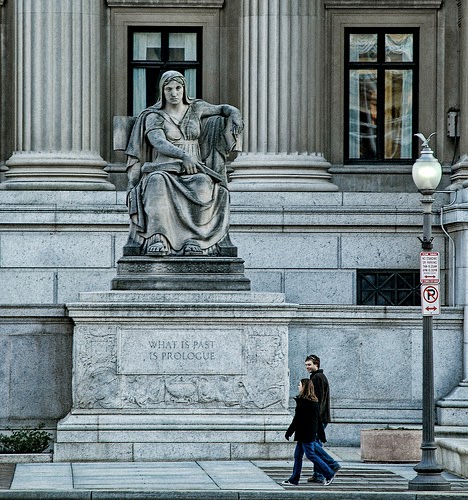
So John
and I went to the National Archives building for the first time – and read the
engraving on the wall outside: “The Past Is Prologue.” We went in and asked the
man at the desk about the JFK assassination records, and he got on the phone
and in a few minutes a man appeared – Marion Johnson, who was responsible for
the JFK assassination records.
I only
had a few questions for Mr. Johnson, the first being – why are the records
locked away for 50 years – and not say 20 or 100? Why 50?
And his
response was that 50 years is the amount of time it is estimated until the
people mentioned in the documents are dead.
Well to
me that was an anachronism – which means “against time,” since if they were
dead, they couldn’t answer any questions or correct the official records if it
was wrong.
My
second question to Mr. Johnson was, “ How do we change that requirement and get
them released?”
The
answer – an Act of Congress.
Well
while that seemed impossible at the time, we sat down again and went over
everything and decided to form a not-for-profit lobbying organization to work
towards the release of the HSCA records – which we called the Committee for an
Open Archives (COA). We officially applied for non-profit status, opened a post
office box and had a stamp made with the name and address to put on envelops,
and began making the rounds of Congress, without much success. Nobody was
interested.
For many years John lived in Philadelphia - in bedroom in a large mansion near
Germantown, owned by Jim and Bonnie – Dayton friends. There we
would retire to a library where John would play cassette tapes of Mae’s radio
shows – which were networked under the name World Watchers International.
One thing not mentioned yet was a big part of John’s
life was his love of the cinema, as he was a big time movie buff went to the theater once or twice a week.
In Dayton, I remember seeing a number of movies with him including Billy Jack,
which played at one theater for over a year. We also saw Executive Action and
2001 a Space Odyssey. In DC we saw Paris, Texas and Bubba Ho-Tep, which was
about an Elvis impersonator who fell off a stage and went into a coma and when
he wakes up in a nursing home, believes he is Elvis, and meets another
patient, a black guy who says he is JFK.
[Correct title of this filim: Bubba Ho-Tep – Elvis and JFK, both alive and in nursing homes, fight for the souls of their fellow residents as they battle an ancient Egyptian Mummy, based on the short story by Joe R. Lansdale, with Bruce Campbell and Ossie Davis http://www.bubbahotep.com/. To view trailer:
[Correct title of this filim: Bubba Ho-Tep – Elvis and JFK, both alive and in nursing homes, fight for the souls of their fellow residents as they battle an ancient Egyptian Mummy, based on the short story by Joe R. Lansdale, with Bruce Campbell and Ossie Davis http://www.bubbahotep.com/. To view trailer:
Then
when Mae Brussell died, John said that he had promised her he would open her
extensive archive and library to researchers setting the foundation for a West Coast research
center in Santa Cruz, near Carmel, where Mae lived.
John recruited me to drive
a U-Haul truck full of his books and belongings from DC to Santa Cruz. Our last
stop in DC was an office of radical Guatemalan activists who were opposing the
dictatorship there. John was helping them raise funds.
It was a
wonderful cross-country trip. We met many interesting people and when we got to
Santa Cruz, set up the Mae Brussel Research Center in a small three bedroom
rancher a few blocks from the beach, where from the backyard you could hear the
seals bark. While on the West Coast we hooked up with Paul Krasner, who Larry
Flint had named editor and publisher of the radical color glossy Rebel
Magazine, which included an article by Mae on the Nazis at Dealey Plaza.
Eventually Mae's daughter took over the MBRC and John moved back east after a
short West Coast hiatus.
After
the NYU conference the next important conference on the JFK assassination was
the ASK conference in Dallas – where a panel was formed on freeing the records
and forming a more permanent organization based in Washington. While the ASK
conference(s) were well organized and attended, they were put together by a for-profit
group who really weren’t interested in the assassination and just wanted to
make a profit. We wanted to form our own organization and organize our own
conferences, not to make money, but to further the research, free the files and
determine the truth.
There
were two meetings to plan the new organization in Dallas, and John Judge
arranged for us to use the main room of the Capitol Hill Quaker Meeting House
for two consecutive days, over which the foundations of COPA were laid out. A
larger general organization meeting was held at a DC hotel in Chinatown, and
the Coalition on Political Assassinations became a reality.
But it
wasn’t until the early 1990s when interest in the assassination began to
increase, mainly because of the mainstream media preoccupation with the making
of Oliver Stone’s film “JFK,” even before the film was finished. After Stone
gave a luncheon speech at the National Press Club, John Judge and I met with
him privately at his hotel room, where he asked us what he could do to help us,
other than give us money.
We had
discussed this among ourselves and decided that Stone could do one thing to
help release the JFK assassination records. We recalled for Stone how at the
end of the movie Executive Action – they ran a little trailer listing the
mysterious deaths, a very controversial subject. We told Stone that if he – at
the end of his movie, make mention of the fact that the JFK files were sealed
from the public for 50 years, that alone would call attention to the issue. And
indeed it did, much more than anyone anticipated.
The
movie motivated enough citizens to contact their Congressmen to complain about
the secret JFK assassination files that Congress was inspired to pass the JFK
Act of 1992, which came about just as COPA was expanding and holding national
conferences in Washington.
For many
of these years John lived in Philadelphia, where he worked for various Quaker
Peace groups, mainly as a counselor for conscious objectors. Though not a
lawyer, John was an expert in military law and the draft, and he counseled
those who wanted to legally avoid the draft and Vietnam because of their
personal beliefs.
While
most people would think of John Judge as a radical revolutionary who disdained the
government, he was a non-violent activist who worked through the system –
always applying for permits for protests and demonstrations, filling out the
tax forms and doing the right thing by law.
Others
whom I met through John – Dick Gregory for instance, were not so formally
inclined, and had no qualms about demonstrating without a permit, handcuffing
themselves to the CIA’s front gate or getting arrested for a good cause.
A few years after Judge introduced me to Dick Gregory I ran into him at
Union station, both of us on the way to catch a train. He asked me how Judge
was doing and when I invited him, he agreed to attend the next conference in
Dallas.
John Judge is probably best known for organizing the
Dallas COPA conferences and holding the moment of silence at the Grassy Knoll.
While I didn’t attend them all, I was at many of them, including the ASK
conference where the foundations of COPA were laid. On the last day of the
conference, while John was sitting on a panel discussing future action, he had
instructed me to hold a preliminary meeting of our new organization with a
dozen, invitation only guests, which I did. We met at the nearby West Side Pub
– Bill Turner being the most recognized personage present, and laid out some
basic objectives of the new organization that didn’t yet have a name, and agreeing
to reconvene in Washington D.C.
Some of the Dallas COPA conferences were even more
significant than ASK, with a few being rather memorial. One time, the year
Gorbachev visited Dallas, I recognized Bob Groden’s son on my flight, and
caught a ride to the hotel with Groden, making a pit stop at his favorite
barbeque. Also in the cramped car was, one of Jack Ruby’s dancers, Shari Angel
and her dog, a little yapper that would never shut up, and darted about the van
with a few other Groden friends. When we got to the Hotel Lawrence, a third
class but clean joint, I was going to check in but the dog ran past me and
proceeded to deficate all over the lobby floor to the screams of others trying
to check in, and a mahem ensued. So I headed to the bar to let the chaos play
out.
The year Dick Gregory spoke was a good year, as we
used the large Grand Jury room just across the street, and there were some
excellent presentations by John Judge, T. Carter, Joe Biles, Walt Brown, Phil
Melanson and Lisa Pease.
Of course, whenever in Dallas, one of the mandatory
side trips is to North Dallas to Campisi’s Egyptian Lounge, where John Judge
presided over many fine meals and where many researchers became friends. As T.
Carter paraphrased JFK saying that there were never so many great minds at one table, except when JFK dined alone.
The most important meal in Dallas was a luncheon
meeting at the restaurant at the top of the needle at the Omni – which slowly
turns so you get a good panoramic view of Dallas as you eat. This particular
luncheon included John Judge, the late Gene Case, T. Carter, Judge Joe Brown
and a few others, with the topic of discussion being the establishment in
Washington of a permanent researcher center and museum.
[See: Dallas Luncheon Meet http://jfkcountercoup2.blogspot.com/2014/05/first-museum-meeting.html ]
[See: Dallas Luncheon Meet http://jfkcountercoup2.blogspot.com/2014/05/first-museum-meeting.html ]
Of all the Dallas COPA events John Judge organized,
there was one particular major anniversary event where we set up a sound system
at Dealey Plaza and a half-dozen speakers spoke eloquently before and after
John held the moment of silence. I recorded the speakers with a cassette tape
recorder I placed on Zapruder’s perch, and later transcribed it and posted it.
I called it The Event that Didn’t Happen after I heard Bob Porter of the Sixth
Floor museum tell Dan Rather that “nothing was happening” at Dealey Plaza that
day – when if he had looked out his office window, he would have seen a few thousand people and
the COPA memorial service.
[See: http://jfkcountercoup2.blogspot.com/2014/05/dealey-plaza-copa-memorial-112298-35th.html ]
[See: http://jfkcountercoup2.blogspot.com/2014/05/dealey-plaza-copa-memorial-112298-35th.html ]
While John Judge’s role in the 50th
anniversary celebration at Dealey Plaza is well documented elsewhere, we will
see how much a legacy he left when we see who shows up on the Grassy Knoll on
November 22, 2014, without the Sixth Floor, Penn Jones or John Judge. As
William West, a Pearl Harbor survivor once told me, “Everyone forgets us on
December 8th.”
The focus of the media’s attention on the 50th
anniversary, Dallas was certainly the cosmic center of the universe for memorial
moments and conferences, but now, as John Judge once noted to me, the action
will shift to Washington D.C., where the records and evidence are held at the
National Archives,and the courts and theaters will provide venues for future
events, the next being at American University on June 10th and at
least two conferences on the 50 anniversary of the release of the Warren Report
in September.
About fifteen years ago, after the Kennedy family
asked that President Kennedy be remembered for his policies and administration,
and not just his death, John and I chose the date June 10th and the
JFK Monument at American University as the site of what became an annual
tribute to President Kennedy. There were
a few dozen at the first tribute, including John Newman and Phil Melanson, but
other times there were just a half dozen of us – Dennis Bartholomew, Roger Fineman, Randy Benson, T. Carter and
John Geraghty so we took turns just saying how JFK had influenced us and read
some excerpts from his speech.
As John Judge quoted JFK at the same spot the words
were first utter fifty years earlier, “And we are all mortal,” a basic fact of
life recognized by JFK before his death, and John Judge before his, and
something we all must confront at some point in time.
When notified that I was given the 2013 Mary Ferrell Award for my work on the Air Force One radio tapes, I thought of something she once told me when we met privately in her Dallas hotel room. She had read a heavily researched article I wrote and posted on line - and credited a few other researchers - Dick Russell, Greg Parker, Larry Hancock, Stu Wexler and Robert Howard, and she said that "it will be the independent researchers like you guys who will solve this case."
When notified that I was given the 2013 Mary Ferrell Award for my work on the Air Force One radio tapes, I thought of something she once told me when we met privately in her Dallas hotel room. She had read a heavily researched article I wrote and posted on line - and credited a few other researchers - Dick Russell, Greg Parker, Larry Hancock, Stu Wexler and Robert Howard, and she said that "it will be the independent researchers like you guys who will solve this case."
Then after
hearing of the death of Earl Golz I talked to John Judge on the phone about the
deaths of JFK researchers who we should somehow recognize and I began a list that Judge added a few names to. I will try to put a photo and a short bio to each of these names for those who don't know who they are. .
Penn
Jones
Seth
Kantor
Sylvia
Meagher
Jacob
Joestein
Mae
Brussell
Larry
Howard
Larry
Ray Harris
Mary
Ferrell
Harold
Weisberg
Jack
McKinney
Norman
Mailer
John
Davis
Sarah
McLendon
Phil
Melanson
George
Michael Evica
Rich
DelaRosa
Fletcher
Prouty
Jack
White
Gene
Case
Roger
Feinman, Esq.
Tim
Carroll
Kevin
Walsh
Hal
Verb
Carl
Oglesby
Gaeton
Fonzi
Earl
Golz
And, now we must add the name of John
Judge.
But with their deaths, as we live on, it is our
mutual burden to pick up where John and the others left off, continue the work
they were doing, and complete the goals they set for all of us.
BK NOTES:
There will be a Celebration of the life of John Judge on May 31, 2014 from 1-5 pm at the National Press Club in Washington D.C. Because of room space is limited and refreshments will be served, you must be invited and RSVP. If you knew John and would like to attend please contact Marilyn Tenenoff at marigoldediting@yahoo.com
As we have for the past 15 years, we will meet under the banner of COPA, maybe for the last time, at the JFK Monument at American University at noon on June 10, 2014, where the memory of JFK and John Judge and the other researchers who have passed away will be invoked, an event that will be open to the public.
John Judge Assassins Historic Tour of Washington D.C.
http://jfkcountercoup2.blogspot.com/2014/05/john-judge-historic-tour-of-washington.html
With John Judge at the Archives II
JFKCountercoup2: With John Judge at the Archives II
Bottlefed by Oswald's NANA - http://jfkcountercoup2.blogspot.com/2012/07/bottlefed-by-oswalds-nana.html / http://politicalassassinations.com/2012/07/was-oswald-bottlefed-by-nana/
Hinkley and Company - http://educationforum.ipbhost.com/index.php?s=68deecba272b6402344aa7f06bcf62d2&showtopic=5458
The Washington Post gave John an very nice send off:
John Judge, independent investigator of historic events, dies at 66 - The Washington Post
(FYI - Robert Gray is the photographer of the picture they posted, and a COPA volunteer in Dallas 2013)
Much different than the bitter sarcasm they previously spewed, with John's response:

Friends Notice:
Washington, DC - John Patrick Judge passed away at the age of 66, just as he had lived – with
courage in the midst of pain. An internationally acclaimed researcher, writer
and speaker, as well as a lifelong anti-militarist anti-racist activist, and
community organizer, Judge died on April 15 due to complications from a stroke
suffered in early March.
Judge’s primary areas
of research were the assassinations of President John F. Kennedy, Robert
Kennedy, Malcolm X and Dr. Martin Luther King, Jr., as well as totally unique
research which he conducted on-the-ground about the massacre in Jonestown,
Guyana. He is a co-founder of the Coalition On Political Assassinations (COPA),
and organized COPA's annual conference in Dallas. The 2013 COPA conference drew
more than 300 researchers and activists to Dallas on the 50th anniversary of
John Kennedy’s death. Amid the national furor when the feature film
"JFK" came out in 1992, Judge was one of the key public proponents
behind the creation of the Assassination Records Review Board. One of his last
efforts was to press for release of some of the thousands of Kennedy and Martin
Luther King, Jr. assassination records still kept classified by the CIA and the
FBI.
As co-founder of 9/11
Citizens Watch, Judge also did investigative research on the background and
details of the attacks of September 11, 2001. He worked with family members of
the victims to push for a federal investigation and closely monitored the work
of the 9/11 Commission.
Judge was also a
co-founder of CHOICES, an organization engaged since 1985 in countering
military recruitment in DC area high schools and educating young people about
their options with regard to the military. Beginning with the war in Viet Nam,
Judge was a life-long anti-war activist and supporter of active-duty soldiers
and veterans.
From 2005 to 2007,
Judge served as Special Projects Assistant to Representative Cynthia McKinney
of Georgia. One of his many undertakings in Congress was to advocate on behalf
of active-duty soldiers who received harsh sentences for declaring themselves
conscientious objectors and others who claimed to have been tortured in
military brigs. He helped write the Articles of Impeachment against President
George W. Bush which Representative McKinney introduced in December 2006,
before leaving office.
At the time of his
death, John Judge was working on creation of a Hidden History Museum and
Research Center in Washington, DC, to educate a new generation about covert
operations, and to support the work of investigative journalists and
researchers looking into the National Security State and the rise of secrecy,
government plans for extra-Constitutional jurisdiction during emergencies, and
threats to civil liberties and international relations. Some of his writings
can be found at judgeforyourself.org.
Acclaimed nationally and internationally for his vast store of historical knowledge, Judge wrote: "Under the evil genius of Allen Dulles, whose espionage attacks on the Soviet Union date back to the 1920's, $200 million in Rockefeller and Mellon funds was directed into the hands of Hitler's spymaster Reinhard Gehlen and his 350 Nazi spies, who formed and founded our Central Intelligence Agency in 1947."
An avid public
speaker, Judge never spoke about himself but rather, humbly retained a tireless
devotion to the search for truth beyond the official government or mainstream
media record. Until his final days, Judge was a seeker of truth and justice of
the first order. He is irreplaceable in the annals of serious research and
documentation.
John Judge is survived
by his long-time companion and life partner, Marilyn Tenenoff, and thousands of
friends and admirers across the country and around the world. A celebration of
his life will be held in late May.
In lieu of flowers, tax-deductible donations can be made to support the preservation of Judge's books and archives in a new Museum of Hidden History, P.O. Box 772, Washington, DC, 20044.
In lieu of flowers, tax-deductible donations can be made to support the preservation of Judge's books and archives in a new Museum of Hidden History, P.O. Box 772, Washington, DC, 20044.

There's usually a
nasty plot behind what seems so decent.
It's often greed or selfish hate, in ancient times and recent.
John Judge's aim is just to find the truth and then to show it.
So we can change the world by letting all the people know it."
(from a poem by Susan McLucas)
It's often greed or selfish hate, in ancient times and recent.
John Judge's aim is just to find the truth and then to show it.
So we can change the world by letting all the people know it."
(from a poem by Susan McLucas)


John Judge - Photo by Mo Murphy
Many thanks to Patrick McCarthy for proofing and editing this and other recent articles and blog posts.



.JPG)
