Saturday, May 11, 2013

Phil Ochs at Dealey Plaza?


Phil Ochs at Dealey Plaza?   

By William E. Kelly, Jr.

"Captain Fritz questioned him and said the President had been killed…Oswald replied, 'people will forget that within a few days and there would be another president.' Oswald felt the State was so unfeeling that grief for its fallen leader would be short-lived. He could not have been more wrong. 'A man so-filled with life even Death was caught off guard,' as the folk-singer Phil Ochs described JFK, and when he died, will never be forgotten." -  Gary O’Brian  Oswald’s Politics [1.]

 “A man so filled-with life even Death was caught off guard,” is just one of the things Phil Ochs said of JFK.

Ochs also claimed knowledge of a plot to kill the president before it happened, and according to his college room mate and best man Jim Glover, Ochs was a witness to the assassination as “a national security observer” at Dealey Plaza.

In following the assassination of President Kennedy for as long as I have I thought I had heard it all, but one of the more bizarre conspiracy theories I’ve come across is the idea that Phil Ochs had expressed foreknowledge of the assassination, was present at Dealey Plaza as “a national security observer,” and kept those facts secret in fear for his own life.

Ochs then committed suicide on April 9, 1976 at the age of 35, a death some believe should be considered suspicious.

I took a particular interest in this theory because I had started to compile a list of those who had expressed foreknowledge of the assassination, and in reviewing their backgrounds, tried to determine if they actually knew about the plot to kill the president from those who could have actually been involved. Phil Ochs was a new name to that list. [2]

I also took particular interest in this allegation because I had actually knew Phil Ochs for a few hours one night when I was a teenager, and I thought that it would be pretty simple to determine whether he was in Dallas that day or not.

Boy was I wrong.

I crossed paths with Phil Ochs at the Democratic National Convention in Chicago in late August 1968 when we were both roaming among the rooms reserved for the Eugene McCarthy campaign on the 15th floor of the Conrad Hilton Hotel.

While much is lost in the fog of the riots that occurred, I clearly remember Ochs on the last night we were there, sitting on the floor in the hall playing a guitar and singing, serenading a dozen or so McCarthy volunteers, myself included. And while Ochs and I didn’t personally meet or talk, we sat a few feet from each other for a few hours while he played guitar and sang and I listened and, at seventeen years old, had my first alcoholic drink - a whiskey on the rocks. A few hours later the Chicago police raided the 18th floor and busted us all, an event that would make the news and a few paragraphs in the history books. [3]

So after I developed an interest in the assassination of President Kennedy, I was quite surprised to learn that Phil Ochs had expressed foreknowledge of the assassination and may have actually been at Dealey Plaza as a “national security observer” to the murder.

The source of this particular conspiracy theory, folk singer Jim Glover, is a free spirited musician and folksinger who still performs today. I had met Jim on John Simkin’s Education Forum, [4] and he is now a Facebook friend.

Jim Glover first called my attention to the Dealey Plaza photograph that he says includes his old friend Phil Ochs, standing on the Houston street sidewalk behind a few Dallas cops peering up towards the top floors of the Texas School Book Depository with weapons drawn. [5]


Since such positive photo identification has been often shown to be false or inconclusive, I have not relied on it in my analysis, which is based on the background of Phil Ochs, his known contacts and associations as an attempt to determine if he could have had foreknowledge of the plot to kill the president if in fact it was a “national security” event.

An unofficial internet profile of Ochs notes that he was, “Born in El Paso, Texas on December 19, 1940, Phil and his family moved frequently during the first few years of his life. His father, Dr. Jacob Ochs, had been drafted by the US Army and assigned to various military hospitals in New York, New Mexico and Texas. In 1943, Dr. Ochs was shipped overseas, returning two years later with a medical discharge. Upon his return, he was immediately institutionalized and didn’t return to his family for another two years. During that time, he was subjected to every ‘treatment’ imaginable, including electroshock ‘therapy.’ When he finally returned to his family in 1947 he was but a shell of his former self, described by Phil’s sister as “almost like a phantom.” Beginning in the fall of 1956, Phil Ochs began attending Staunton Military Academy, the very same institution that future ‘serial killer’/cult leader Gary Heidnik would attend…. During Phil’s two years there, a friend and fellow band member was found swinging from the end of a rope (…ruled a suicide). Following graduation, Phil enrolled at Ohio State University, but not before, oddly enough, having a little plastic surgery done to alter his appearance (doing such things, needless to say, was rather uncommon in 1958)…”

It was at Ohio U in Columbus where Oaks met folksinger Jim Glover, who became his roommate, taught him how to play guitar, gave Ochs his first guitar, losing it on a political bet, and together they formed the folk duo the “Singing Socialists,” later changing the name to the “Sundowners.”

Glover quit school and moved to New York City, becoming a part of the Greenwich Village folk music scene, which was then just beginning to blossom. Shortly thereafter, just before graduation in 1962, Ochs too quit school and joined Glover in New York where he too became part of growing, restless counter-culture of that era.

As the epitome of the 1960s-era protest singer Phil Ochs was known for writing songs fused with meaning and anti-establishment themes, including, "I Ain't Marching Anymore", "Changes", "Love Me, I'm a Liberal", "Outside of a Small Circle of Friends", "Power and the Glory", "There but for Fortune", and "The War Is Over". [6]

       FLASHBACK 092068 CHICAGO DEMOCRATIC NATIONAL CONVENTION

Although I find it hard to believe, as I write this, the Disc Jockey (on WXPN FM) plays “Draft Dogger Rag” - in honor of the anniversary of Ochs’ April 9, 1976 death, which gives you a good example of the irony and wit he used to get across an unpopular notion - the political hypocracy of Washington. [7]

Oh, I'm just a typical American boy from a typical American town
I believe in God and Senator Dodd and a-keepin' old Castro down
And when it came my time to serve I knew "better dead than red"
But when I got to my old draft board, buddy, this is what I said:

CHORUS
Sarge, I'm only eighteen, I got a ruptured spleen
And I always carry a purse
I got eyes like a bat, and my feet are flat, and my ashma's getting worse
Yes, think of my career, my sweetheart dear, and my poor old invalid aunt
Besides, I ain't no fool, I'm a-goin' to school
And I'm working in a DEE-fense plant

Hearing his sharp, distinctive voice flashed me back to the 1960s as I recalled that song being played on the radio - usually late on a Sunday night when “Meatball Fulton” spun the discs and told the tales from the underground on Philadelphia’s WXPN, (who were still playing Ochs songs in 2013), or you could sometimes hear Ochs on Dave Herman’s Marconi Experiment, but they were the only programs I knew of that would play Phil Ochs’ songs. [8]

“I believe in God and Senator Dodd and a-keepin’ ol’ Castro down…..”

Hearing his voice immediately threw me back once again to Ochs singing in the hotel hall in Chicago, a momentary flashback to the evening the Vietnam Peace Plank had lost and the McCarthy volunteers, mostly high school kids (like me) or college students suddenly had nothing to do, as the campaign was officially over. Out in the hall Ochs began to sing, possibly “The War is Over,” and a bar tray on wheels came down the halI was given a whiskey highball on the rocks, and sat down on the floor with the others and listened to Phil Ochs play the guitar and sing in his sharp, distinctive voice.

Then I went and laid down in a back room and while I was asleep, all hell broke loose, the Chicago Cops stormed the 15th floor and busted everybody - me included - roused out of bed and beat with a billy club by cops - tear gas cut my eyes and blood dripped down my face. The subdued hotel hall party suddenly became a combat zone, and that was the last time I saw Phil Ochs.

I do remember, about a year later, buying his album that showed Ochs’ grave stone on the cover and indicated that he died in Chicago.  It contained songs about our Chicago experience, including “William Butler Yeats Escapes from Grant Park Unscathed.” [9]

And now, according to Jim Glover, there he is in the photo at Dealey Plaza, a blurry, ghostly figure of a young man standing back against the Dal-Tex building in a photo obviously taken just shortly after the assassination of the President, with policemen with weapons drawn looking towards the assassin’s lair in the upper floor windows of the Texas School Book Depository building.

Like a fly on the wall, the casually dressed young man seems to be just standing back taking it all in. Is that really Phil Ochs, the folk singer? If so, what’s he doing there? Was he really there as a “national security observer?”

What is a “national security observer”?

And how, I wondered, could a radical leftist protest singer like Phil Ochs become involved with the “national security state”? 

It was a question that I was surprised Jim Glover could answer so quickly, and to my satisfaction.
      
                                                           WIKI OCHS

But first I wanted to check to see what the internet had to say about Phil Ochs.

Of course Wiki is not a reliable or citable source for college papers, books or serious research, but it is a good place to start. As some speculate it has CIA ties, and posts questionable assertions regarding the assassination of President Kennedy, I thought it a good place to get the official, mainstream story before diving into the truth.

The Wiki entry confirmed my own recollections of Chicago in ’68, Jim Glover’s association with Ochs in college and the effect of the assassination on Ochs.

Of Chicago Wiki says: “Despite warnings that there might be trouble, Ochs went to Chicago both as a guest of the McCarthy campaign and to participate in the demonstrations. He performed in Lincoln Park, Grant Park, and at the Chicago Coliseum, witnessed the violence perpetrated by the Chicago police against the protesters, and was himself arrested at one point.”

Yea, some point.

As for school, the Wiki entry notes: “when he graduated [from Staunton Military Academy, Va.] Ochs returned to Columbus (Ohio) and enrolled in the Ohio State University…to study journalism and developed an interest in politics, with a particular interest in the Cuban Revolution of 1959.”

In regards to Jim Glover, it says that, “Glover taught Ochs how to play guitar, and they debated politics…Ochs and Glover formed a duet called ‘The Singing Socialists,’  later renamed ‘The Sundowners,’ but the duo broke up before their first professional performance and Glover went to New York City to become a folksinger.” [10]

                                          UNDERCOVER IN COLUMBUS

So I sent my new Facebook friend Jim Glover a PM - Personal Message and asked him how he met Ochs, what Ochs doing at Dealey Plaza and how Ochs was connected to “the national security state?” [11]

Jim Glover:

“Phil first picked up the guitar when we were in college and Steeb Hall roommates (at Ohio State University in Columbus, Ohio). We were both in the ROTC (Reserve Officers Training Corp…. I was a private ROTC Army, Phil was ROTC Air Force Sergeant….It was a military culture because ROTC was mandatory and Phil was a sergeant in the Air force and I was private Army cadet.... He liked to pull rank on me and I resented it…but we had a ball anyway.”

“At first Phil was Gung Ho...’Commies’ were the bad guys and he seemed like it would take a lot of work to turn him around, but I did in short order. It was kinda like I ‘sheep dipped’ him for his future mission. He bragged about his photographic memory and how at [Staunton, Va.] Military Academy he was friends with Barry Goldwater's son. In 74 he told me he knew John Dean there too when he also confessed he was working with an up and coming young Air Force officer…”

“Phil (got a lot of his song ideas from the newspapers and) read me stories about how the mob fixed the election, about Lee Oswald defecting to Russia, and about how U2 pilot (Gary) Powers should have taken his suicide pill and on and on. He also was mad at me for going to a demonstration to protest Wernher Von Braun speaking on campus. I was prejudiced about Nazis I guess and Phil was pissed that one of the students who talked me into it was a Socialist Worker's Party guy. It was around then he spilled the beans about a big red scare surveillance program on campus and the first time I heard the term was when Phil said I was ‘Fair Game.’"

“Our last quarter at Steeb Hall he got super radical all of a sudden …wrote articles in defense of Castro for the Steeb Hall newsletter he put out himself called ‘The Word’ and made all the mimeographed copies. He also reported for the Ohio State Paper ‘The Lantern’. His first song was about the Cuban invasion - ‘The Bay of Pigs,’ which we would sing as the Singing Socialists. After we did a Republican big wig house party an angry white man came up and asked us if we were Communists...Phil was a bit worried and wanted us to change our name to the "Sundowners" because it was more ‘euphonious’. I went along....Trouble is it took all the fun out of it for me.”[12]

                                           ROTC, COINTELPRO & CHAOS

Reserve Officer Training Corps (ROTC) was also, at one time, mandatory for all freshmen male students at the University of Dayton, Ohio, before I got there, but student protests ended the practice. Many students however, continued to voluntary take the ROTC program and I took classes in military history and strategy with the ROTC professors and cadets.

When college students began to organize anti-Vietnam war protest demonstrations, it was the ROTC students who were recruited to infiltrate the protesters as undercover informants and in some cases, instigators and agitators who drew students out of the crowd so they could keep track of them. Sometimes they were sent from one campus to another. [13] This was the FBI’s COINTELPRO program, which was first revealed in the early ‘70s after anti-war activists broke into the Media, Pennsylvania FBI office, stole COINTELPRO files and distributed them to the newspapers and magazines. And like the assassination of President Kennedy, that crime, what the professionals in the trade call a “black bag job,”

The CIA also ran a similar operation CHAOS, but since they were not legally able to conduct operations in the continental United States, the FBI’s undercover network as used against the Klu Klux Klan, targeted student protesters and they were supplemented by the US Army intelligence, usually the Army Reserve units, whose surveillance of the civil rights demonstrations is also well documented. (See: MLK, Memphis). [15]

The FBI and military’s use of undercover informants and agitators is also exemplified at Kent State, where one such agitator is now believed to have provoked the Army reservists into shooting students, [16] and in the case of the Camden 28. [17] The Camden, NJ anti-Vietnam activists were assisted and provoked by an FBI informant and instigator - ex-USMC undercover operative Bob Hardy, who like Oswald and Ochs, fits the covert operative personality profile. [18]

So if Phil Ochs was a Staunton (Va.) Military Academy graduate [19] and Air Force ROTC sergeant involved in undercover surveillance of radical college students, he certainly could have continued his association with the military-intelligence network that had previously conducted surveillance of campus radicals.

                                             GOODBYE COLUMBUS

Columbus is the Ohio state capitol, and the film location of a popular early 70s date movie - Goodbye Columbus, based on a Philip Roth novel, first published in the Paris Review, which gives a colorful insight into the sports-jock world that prevailed before the bloom of the counter-culture and the Vietnam War created a political divide. [20]

If  the Secret Service were preparing for a presidential visit to Columbus, Ohio, they would check with the Protective Research Section (PRS) to see if there were any threats to the president in that vicinity. From the files they would learn that Columbus was the home of prominent Hustler magazine pornographer Larry Flint, who also published Rebel, a glossy magazine that included articles on the JFK assassination by Mae Brussell, the housewife researcher and Yippster humorist Paul Krasner. Flint himself became the victim of an assassination attempt. [21]

The government files would also reflect that Columbus, Ohio is also the headquarters of an obscure semi-quasi-government intelligence agency - The Defense Industrial Security Command (DISC), [22] which deserves attention in regards to the security of such corporate entities as Texas defense contractors Bell Helicopter, General Dynamics and Collins Radio and the roles their employees played in the assassination drama. [23][24][25].

When Gordon Novel was sought for questioning by the New Orleans grand jury in 1967, he avoided the subpoena by fleeing at first, to Columbus, Ohio, where the governor himself (Rhodes) refused to extradite him, and then to McLean, Virginia, near where the CIA headquarters is located. Something peculiar was going on in Columbus, as well as McLean. [26]

In summary, Phil Ochs, after graduating from an elite Virginia military academy, served as a sergeant in the Air Force ROTC at Ohio State University, where he spied on campus radicals and was encouraged to infiltrate student protest groups. He may have switched ideological sides, but appears to have maintained his association with the US military intelligence officers that he worked with in college. They must have took note of the fact that one of their ROTC cadets was playing guitar, writing protest songs and articles and fermenting unrest, which was becoming something of a popular campus pastime and cultural phenomenon, one they certainly would have wanted to keep tabs on.


                                                      PHIL OCHS AND BOB DYLAN

In looking through the published literature on Bob Dylan, there is frequent mention of his association with Phil Ochs, such as when Dylan biographer Bob Spitz writes, “Phil Ochs stumbled over to Dylan’s table, worked up over some secret government conspiracy or another.” [27]

So Ochs was himself considered a conspiracy theorists before it was popular and then went nearly a full decade without seeing Dylan, who went on to fame and fortune, while Ochs continued to write and sing protest songs, an out of date and almost obsolete musical genre that was totally overrun by rock and roll and then the drones of disco. While Dylan seemed to roll with the punches, and go his own way, Ochs seems to have been stuck in a rut, though he kept writing songs and singing away.

Both Phil Ochs and Bob Dylan did write songs about similar subjects, including the Civil Rights movement, the John Birch Society and assassinated civil rights leader Medgar Evers.

It is quite clear that if Medgar Evers’ murder by a sniper was properly investigated and prosecuted, JFK wouldn’t have been killed the way he was. It was only because of a young, assist. DA that justice was served in Evers’ case, and his widow was part of the second inauguration of President Obama in 2012.

Dylan sang his song “Just a Pawn in their Game” at the March on Washington when Martin Luther King, Jr. gave his famous “I Have a Dream” speech.

Anthony Scaduto, in Dylan - An Intimate Biography, [28] compares and contrasts the Ochs and Dylan songs about the assassination of Medgar Evers:

“A comparison of the way Dylan and Phil Ochs each handled the murder of civil rights leader, Medgar Evers, points it up. Ochs, and everyone else writing the Broadside song, saw the killing as simply a story to be set to music. The tradition is old and honorable. Ochs, in The Ballad of Medgar Evers, tells how Evers, as a boy of fourteen in Mississippi, saw a friend hung because of his color. The lynching was branded on his brain. And then, quite simply, without melodrama, Ochs writes about the killer who waited in ambush and shot Evers down. And when they buried him the nation gained a killer but lost a man. Dylan however, handled it differently in Only a Pawn in their Game. He immediately establishes that a bullet fired from ambush takes Evers life, but from there he takes it several large steps forward. The man who fired that bullet is not to blame. He is only a pawn in the game, a game in which the politician preaches to the poor whites that they’re better than blacks, and the politician rises to power on his demagoguery while the poor white remain ‘on the caboose,’ at the bottom of the heap. Governors, sheriffs, soldiers, all the law enforcement crowd - and the preachers and educators - teach him that his white skin is a protection, teach him to walk in a mob and to lynch blacks. And they buried Evers ‘as a king’ but when the man who fired the gun eventually dies, his epitaph will be that he was only a pawn in their game.”


                                            PHIL OCHS AT DEALEY PLAZA

Jim Glover:

“Phil was into the investigation of the plot before Dallas. He came over to my apt when (my wife) Jean was gone to tell me that there was a plot to kill President Kennedy. He asked me if I knew anything and that he was going to the FPCC to find out more. Phil said he was working for the Fair Play for Cuba Committee in order to find out more about the plot and I said I would let him know if I heard anything ... I kinda remember we were supposed to meet somebody in a subway station but they never showed so I never met the Fair Play for Cuba guys, but many years ago I called VT Lee of the Veterans for Peace and he told me ‘Oh yes Phil was working with us.’” 

“Before Phil went to Dallas he said his Mom told him to get a haircut (good advise) and he said he went there with one of the Gambino boys... one his age.”

 “I now believe anyone who went there to watch or report were being set up in case the ‘Oswald all alone’ thing did not pass, the next patsies would be us Castro sympathizers and then the Mob... or both.  I know it sounds twisted, but that is why they had to stick to Oswald ‘the lone nut’ who I now believe…. was really working to kill Castro….”

“Phil did not say who told him to go to Dallas and it probably saved our lives because I would have talked. All my life I got in trouble because I talked, so they used me for that. Phil did say he was working for ‘National Security Domestic Division’ of ‘something like the CIA’ and that FBI Hoover was the bad guy. Soon after that two men identifying themselves as FBI came over and asked me if I knew where Phil was...Of course I thought they really knew, but I lied and didn't even tell them about the Kennedy plot to protect Phil.”

“It was a few months after
Dallas that Phil showed up at our new apt at Leroy St. He asked where I was and I told him about what I saw when I was forced onto the Shadow Bus after an airport stop in Texas….Phil said ‘I told you not to go" and I said we were trying to find you but nobody knew where you were.’"

“Next he said he was in Dallas as a ‘national security observer,’ a new role to me but it made sense….About his Dallas trip he only told me once and that was that he was standing on the street and when JFK was shot he went towards the scene and saw the commotion ..... I don't remember him saying he was standing in the street keeping watch on Elm and Houston when the Limo passed but a few weeks ago I found him there, a bit blurry but it is in (the film) ‘The First Shot’. Phil did say he thought it was a Para-Military operation.”

“I asked him if he could prove he was there and he said he was being filmed standing by the garage door of the Dal/Tex building. He also went over toward the crowd and saw a lady crying….Phil told me it was a paramilitary squad that did it…Soon after I told his story during a solo set at the Gaslight and Phil found out he said ‘Are you trying to get me killed?!’ So after that I was more cautious about talking...but I never was quiet. Phil told me that he was warned - he did not tell me who, he was warned that if he talk they would say that he was crazy.” [29]

                                           DYLAN AND JFK ASSASSINATION

According to his biographer: “Dylan was on his way uptown to [his and Och’s manager Albert] Grossman’s office on the afternoon of Friday, November 22, 1963, when John F. Kennedy was shot in Dallas. ‘I watched it at my manager’s office,’ Dylan later told me. ‘The next night, Saturday, I had a concert upstate,…There was a really down feeling in the air. I had to go on stage. I couldn’t cancel. I went to the hall and to my amazement the hall was filled. Everybody turned out to the concert. The song I was opening with was The Times They Are A-Changin’ and I thought, ‘Wow, how can I open with that song? I’ll get rocks thrown at me.’ That song was just too much for the day after the assassination. But I had to sing it, my whole concert takes off from there … I know I had no understanding of anything. Something had just gone haywire in the country and they were applauding that song. And I couldn’t understand why they were clapping or why I wrote that song, even. I couldn’t understand anything. For me, it was just insane.’” [30]

“When he returned to the Village he, Suze and Carla sat and watched the national tragedy through the rest of the weekend and into the Monday morning funeral. Like so many across the nation, they were engrossed in the events unfolding before them: the murder of Oswald, the funeral, the continual replays of the death of Kennedy, the confirmation of a new president, the widow refusing to change her blood-soaked dress because she wanted the world to see her husband’s blood, to see what they had done. Through it all Dylan sat and watched and said little, just feeling the emotion of it. He drank a little wine, and played Berlioz’s Reguiem over and over.”

“Phil Ochs also felt it in Bob: ‘Oh, yea, I was overcome with it. Yeah, that feeling was everywhere. I was almost destroyed with that very same thing. You’re sticking your neck out, a public figure, and there’s an obvious fear. You’re political and obviously the bad guys are on the loose and maybe gonna kill anybody who’s out front, and you get scared. Bob never talked about it, but it was there.”

“Although many felt it in Dylan at the time, he denies it today. ‘I didn’t feel it any more than anybody else,’ he told me. ‘We were all sensitive to it. The assassination took more of the shape of a happening. I read about those things happening to Lincoln, to Garfield, and that it couldn’t happen in this day and age was not too far-fetched. It didn’t knock the wind out of me. Of course, I felt as rotten as everyone else. But if I was more sensitive about it than anyone else, I could have written a song about it, wouldn’t I? The whole thing about my reactions to the assassination is overplayed.’”

“Yet, despite Bob’s denial, the murder did have an enormous effect on him. He signaled that feeling to very close friends, and a couple of weeks after Kennedy’s death, Dylan gave a disastrous speech that indicated how much the assassination had troubled him. He went to the grand ballroom of the Hotel Americana in New York to accept the Tom Paine Award of the Emergency Civil Liberties Committee for his work in the civil rights campaigns….”

“…Dylan began to think of Kennedy’s murder, which had been deplored by speaker after speaker that night and he said: ‘I’ll stand up and be uncompromisable about it, which I have to be to be honest. I just got to be, as I got to admit that the man who shot President Kennedy - Lee Oswald - I don’t know exactly what he thought he was doing, but I got to admit honestly that I, too - I saw some of myself in him. I don’t think it could have gone that far - I don’t think it could go that far. But I got to stand up and say that I saw things that he felt, in me - not to go that far and shoot…’ Some members of the audience began to boo and his, and Dylan went forward: ‘You can boo, but booing’s got nothing to do with it - it’s uh - I just uh - I’ve got to tell you, man, it’s the Bill of Rights, it’s free speech and….’ Someone broke in and said his time was up and Dylan later claimed the chairman began kicking me under the table, and he finished up by quickly saying he accepted the award in behalf of James Foreman and the Student Non-Violent Coordinating Committee and he went off amid boos and some applause, beat it out of there.”

Dylan said, “All I can say is politics is not my thing at all. I can’t see myself on a platform talking about how to help people. Because I would get myself killed if I really tried to help anybody. I mean, if somebody really had something to say to help somebody out, just bluntly says the truth, well obviously they’re gonna be done away with. They’re gonna be killed.”  [30 Continued]

                                                     “CRUCIFIXION”

 In a tribute to JFK, Phil Ochs wrote "That Was the President," and in the dust jacket liner notes commented: "My Marxist friends can't understand why I wrote this song and that's probably one of the reasons why I'm not a Marxist. After the assassination, Fidel Castro aptly pointed out that only fools could rejoice at such a tragedy, for systems, not men, are the enemy." [31]

Ochs also wrote another song that is said to be inspired by the assassination of President Kennedy - “Crucifixion.” [32]

Wikipedia has a page devoted to just to the song that says Ochs wrote "Crucifixion" during a two-hour car ride in the middle of his November 1965 concert tour of the U.K. According to Ochs's manager, Arthur Gorson, Ochs “was ‘wary’ of how his audience might react to the new song because it did not have an explicit political message. He needn't have worried; his first public performance of ‘Crucifixion’ was greeted by a standing ovation.”

Wiki: “The song is about the rise and fall of a hero, and the public's role in creating, destroying, and deifying its heroes….’Crucifixion’ usually is interpreted as an allegory likening the life and assassination of U.S. President John F. Kennedy to the career of Jesus, although the song may refer to other heroes as well. In 1973, Ochs explained ‘Crucifixion’ to Studs Terkel. In the distant past, Ochs said, the people would sacrifice a healthy young man to the gods; today, things were the same. The Kennedy assassination, in a way, was destroying our best in some kind of ritual. People say they really love the reformer, they love the radical, but they want to see him killed. It's a certain part of the human psyche — the dark side of the human psyche.” [33]

Wiki also notes that the first recording of "Crucifixion" was released in 1966 by Jim and Jean, “a musical duo made up of Ochs's college friend Jim Glover and Glover's wife, Jean Ray.” [34]

“In March 1967, U.S. Senator Robert F. Kennedy and journalist Jack Newfield met Ochs, on a plane and Ochs sang ‘Crucifixion’ for them. When Kennedy realized the song was about his brother, tears came to his eyes.” [35]

                                                    ALICE SKINNER

The line in the Wiki entry on Ochs mentions that: “When Kennedy was assassinated on November 22, 1963, Ochs wept. He told his wife that he thought he was going to die that night. It was the only time she ever saw Ochs cry.”

If his wife Alice Skinner saw him cry on 11/22/63 - the day JFK was killed, she would know if he was in Dallas or not. She would know, but however, she has since passed away.

Jim Glover says that Ochs flew home from Dallas late that afternoon, and believes that Ochs wrote the song, “One Way Ticket Home” about that flight. That’s why, he notes, his wife says she saw him cry “that night.”

Ochs told Glover that on the flight home he sat on the plane with a British photographer/filmographer, possibly the same one who filmed him standing on the Houston Street sidewalk. [36]

Another thing that stood out, besides his wife saying that he cried that night, is the Wiki reference to Suzie Rotolo being a witness to the Ochs-Skinner wedding, when Jim Glover served as the best man.

“In 1962, Phil Ochs married Alice Skinner, who was pregnant with their daughter Meegan, in a City Hall ceremony with Jim Glover as best man and Jean Ray as bridesmaid, and witnessed by Dylan's sometime girlfriend, Suze Rotolo….” [37]


                                                    SUZE ROTOLO  - BOB DYLAN

Suze Rotolo was quite a Greenwich Village character, artist, writer, sister to the secretary of folk archivist Alan Lomax, the girl on the cover of Dylan’s popular “Freewheelin’” album, Bob Dylan’s ex, and an illegal visitor to Cuba.  [38]

Suzie Rotolo quite coincidently - earlier came into the  story when it was noted that she attended a summer youth camp with Elliot and Steve Kenan, twins from Philadelphia who also became unwittingly entwined in the assassination saga. It really is a “small circle of friends.”

Elliot Kenan is a folk guitarist who once ran the Guitar Workshop in Philadelphia, while his twin brother Steve was a Temple University student and the publisher of the official programs for the Philadelphia and Newport Folk Festivals. [39]

The Guitar Workshop, originally in North Philadelphia near Temple University, later moved to Sanson Street, just around the corner from Rittenhouse Square, the Heights-Asbury/Greenwich Village hippie hangout where there was a reported Oswald sighting in the summer of ’63. That Oswald event occurred when those involved in the Quebec to Guantamano Peace March held a protest demonstration there. Oswald was also reported seen at an earlier Canadian stop on the march, so there might have been a member of the march who closely resembled Oswald, or he could have been mistaken for one of the Kenin twins, who resembled Oswald in a number of ways.  [40]

There are other questionable aspects of this march related to the assassination, including the fact that the previous San Francisco - Moscow Peace March by the same left wing “ban-the-bomb” peacenik sponsors, passed through Minsk when Marina and Oswald were living there. [41] After leaving Philadelphia, the Quebec to Guantamano marchers went to Washington D.C. where one of the more ludicrous episodes occurred. One of the marchers - black amateur boxer Ray Robinson, got into a fist fight wrestling match in a parked car with former CIA employee James B. Wilcott, who later testified about Oswald’s possible clandestine double agent activities in Japan. [42]

Steve Kenin is also an interesting character. After visiting Cuba, being photographed with Castro, and writing a series of articles about his Cuban adventures in the Temple University student newspaper, Steve Kenin was in New York when Castro visited, and like Jim Glover and Phil Ochs, dropped out of college shortly before graduating. Kenin then traveled around Mexico on a motorcycle. In Mexico City he fell in with a group that stayed at the Quaker hostel Casa d Amegos, where Oswald was also said to have visited. FBI reports indicate Kenin met Oswald and Mexican attorney Homo Bono told Anthony Summers that he saw Kenin give Oswald a ride to the Cuban embassy on the back of his motorcycle, both seeking visas to Cuba. [43]

Tony Summers and other researches have also questioned whether Steve Kenin is the mysterious LICOZY3 - a Philadelphia college student in Mexico City who the Cuban G2 tried to recruit as an agent but instead served as a double-agent under CIA-FBI control. [44]

There is also the question of whether another young American student - folksinger Chris Smither, who was at the University of Mexico City at the time, had any run-ins with Oswald or Kenin or related characters. [45]

Another questions is whether the FBI’s COINTELPRO or the CIA’s CHAOS programs included the surveillance and infiltration of student groups or the folk music political protesters of whom Phil Ochs and Bob Dylan were the principal exponents at the time. 

Ochs’ FBI file, over 400 pages, indicates that they took Ochs seriously, and considered him a threat, though there seems to be no indication that the FBI knew of his continuing association with the Air Force Intelligence or Air Force Reserves Intelligence. [46]

The question that is especially important - did Phil Ochs maintain his association with the US Air Force intelligence officers who ran the undercover ROTC operations against student radicals when he was in college, and who were they?  Who ran Phil Ochs when he was “working undercover” as an infiltration agent? If not the FBI, was it military intelligence or the CIA? [47]

As a witness at Och’s wedding, Bob Dylan’s former girlfriend, Suze Rotolo is a solid link between Phil Ochs and Dylan, whose relationship with Rotolo is best personified by the photo of them walking down 'Positively' Fourth street in Greenwich Village in NY which graced the cover of Dylan’s “Freewheelin’” album.  [48]


The relationship between Dylan and Rotolo was said to have been intense, and their impending breakup may have sparked Dylan’s cross-country road trip in which he and some friends drove from New York City to San Francisco, stopping various places along the way, including Oswald’s old neighborhood in the French Quarter in New Orleans and Dealey Plaza in Dallas.

                                        ROAD TRIP VIA DEALEY PLAZA

While there are other road trips of note that are a part of the assassination lure - such as the Huma Bunker Raid [49], Ruth Paine’s summer vacation [50] (which wound up at Oswald’s apartment in New Orleans), and the caravan that included Marita Lorenz that reportedly went from Florida to Dallas with a cache of arms [51]. Bob Dylan’s cross country trip is illustrative since it included stops at relevant assassination sites in Louisiana and Texas.

Peter Karman, a British writer and reporter for the London Daily Mirror, had introduced Dylan to Suze and Carla Rotolo. Carla was secretary to legendary folk collector Alan Lomax, and her sister Suze and Dylan who would hit it off, famously. Then as they were breaking up, Dylan would take off on this cross country tour. [52]

“Hey,” Dylan reportedly said to Karman, “wanna ride cross-country with us? Gonna do some concerts, ramble ‘round the country. Show ya some of the places I been, like Central City, Atlanta, Greenwood. Hit New Orleans for the Mardi Gras, even.”

Leaving New York for San Francisco, the station wagon included Dylan, Paul Clayton, who drove most of the time, Dylan’s “road manager” Victor Maimudes and Karman, who was later replaced on the trip by Bob Neuwirth. [53]

First they dropped in unannounced to visit American historical icon Carl Sandberg, who Dylan wanted to meet because Woody Gunthre had spoken highly of him. Dylan gave Sandberg a copy of his new album, “The Times They Are ‘a Changin’,” and then they drove to New Orleans, where they were kicked out of a couple of French Quarter bars near Oswald’s old neighborhood.

Then they went to Dallas where, as recounted by Anthony Scaduto in Dylan - An Intimate Biography, they asked directions to Dealey Plaza.

“…On entering Dallas,” Scaduto relates, “Dylan had an urge, ‘Let’s go see where Kennedy was killed.’ They drove around looking for the Texas Book Depository and Dealey Plaza, four months after the murder, lost in downtown Dallas. ‘Where’s Dealey Plaza?’ Dylan asked, leaning out the window, and no one knew, four people, and five, and six, and none of them knew the place. At last, that’s what they said. The seventh man they asked, answered, ‘You mean where they shot that bastard Kennedy?’ Dylan didn’t answer, and the Texan gave them directions. For about a half hour they wandered around the murder scene, Dylan grim and silent, and then back in the car and on their way, and all of them shouting out the windows, condemning all Texans as assassins.”

When they got to San Francisco, Dylan hooked up with Joan Baez, and they visited her sister, who was married to Richard Farina, (author of the novel “Been Down So Long It Looks Like Up To Me”), and had been in the Cuban mountains with Castro when he was a struggling revolutionary. [54]

Also in San Francisco, at the Monterey International Pop Music Festival a few years later, David Crosby of the Byrds tells the crowd that the Warren Report is a lie & that JFK was killed a conspiracy, and dedicates a reworded version of the song, "He Was a Friend of Mine," to JFK. [55]
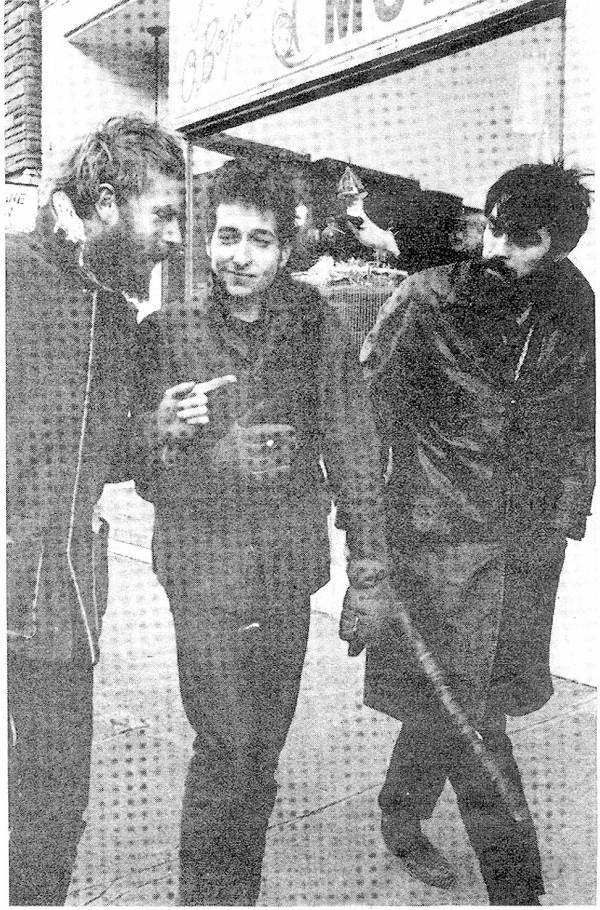


                                             Albert Maher, Bob Dylan and Pete Foreman

                                                      ALBERT LASATER MAHER

Back in New York. Dylan began to associate with Albert Maher, [56] another Castro activist from Texas, who had been to Cuba, protested the banning of travel to Cuba in New York City, was evicted from a Congressional House UnAmerican Activities Committee hearing on Cuba in September 1963, and returned to Cuba after it was made illegal, with Suze Rutolo.  

When Dylan accepted the 1964 Tom Paine award, he did so in the name of the American students who traveled to Cuba, especially those who went after such travel was banned by the government.

Robert Sheldon in his biography of Dylan writes: “…In spring 1964, Life magazine showed Dylan in his surliest mood with Geno Foreman and Albert Maher. Maher, a Harvard Square radical who had visited Cuba in 1963, traveled in 1964 on some Dylan concert tours out of his own romantic radicalism and admiration for the singer. Maher was the son of John F. ‘Big John’ Maher, a millionaire Houston industrialist. The son’s radicalization began at fifteen, when he read Castro, then accelerated in 1961 after the Bay of Pigs. In early 1964, Dylan hung out with Maher sporadically. Some months after Bob and Suze spit up, she and Maher began a long relationship.” [57]

Winsip Custer wrote, “So like a similar personality, Albert Lasater Maher, who like C. Wright Mills [author of “Listen Yankee” (Ballentine, 1960)] was the descendant of a prominent Texas trailblazer and rancher…” John F. Maher. [58]

According to Custer, “Maher's father, John F. Maher, was shown in the 1979 SEC report of Zapata Corporation to own 5.9% of the common stock -- 527,964 shares and was domiciled at 2131 San Felipe, Houston, the address for Hobby Communications, the company of former Texas Governor William P. Hobby whose family was intermarried with U.S. Ambassador to El Salvador and San Antonio, TX businessman, Henry Catto.  Catto's wife, Jessica Hobby Catto, a prominent San Antonio environmentalist served on the Board of Trinity University, a Presbyterian related college, on whose board serves such notable personalities as former U.S. President, George Herbert Walker Bush and Presbyterian pastor, Louis Zbinden.” [59]

So after breaking up with Dylan, Suze took up with Al Maher, who Dylan dedicated his Tom Paine Award. Al is the son of a Houston, Texas industrialist with ties to Hobby Communications and the Zapata Oil corporation

                                         DYLAN & OSWALD
Back in New York Dylan also hung out with Geno Foreman [60] “… a zany motorcycle maverick, Bostonian who appealed to Dylan….”  whose father, Clark Foreman, [61] organized a formal dinner party fund raiser for the Emergency Civil Liberities Committee (ECLC) at the Americana Hotel Grand Ballroom, and gave Dylan the Tom Paine Award for his social activism for civil rights.
As it has been reported: "By 1963, Dylan and Baez were both prominent in the civil rights movement, singing together at rallies including the March on Washington where Martin Luther King, Jr. gave his ‘I have a dream’ speech. Dylan performed ‘Only a Pawn in their Game’ and ‘When the Ship Comes In’... His next album, ‘The Times They Are a-Changin’, reflected a more sophisticated, politicized and cynical Dylan….. By the end of 1963, Dylan felt both manipulated and constrained by the folk-protest movement. Accepting the ‘Tom Paine Award’ from the National Emergency Civil Liberties Committee at a ceremony shortly after the assassination of John F. Kennedy, a drunken, rambling Dylan questioned the role of the committee, insulted its members as old and balding, and claimed to see something of himself (and of every man) in assassin Lee Harvey Oswald..."

Dylan later tried to explain: “When I spoke of Lee Oswald, I was speaking of the times. I was not speaking of his deed, if it was his deed, the deed speaks for itself. But I am sick so sick at hearin ‘we all share the blame’ for every church bombing, gun battle, mine disaster, poverty explosion, and president killing that comes bout, it is so easy to say ‘we’ an bow our heads together. I must say ‘I’ alone and bow my head alone for it is I alone who is livin’ my life.”

Dylan also wrote a long letter-poem, an apology of sorts, to the members of the National Emergency Civil Liberties Committee (NECLC), which was distributed with an accompanying letter by Corliss Lamont. [62. See for complete speech transcript, letter and poem to ECLC].

Author of numerous pamphlets on various political and philosophical issues, ala Tom Paine, copies of Dr. Corlis Lamont’s “Crime Against Cuba” was specifically requested by Lee Harvey Oswald when he wrote to the New York office of the Fair Play for Cuba Committee (FPCC), an office targeted by both the CIA and FBI. The CIA had requested a copy of the FPCC letterhead that they were preparing to use in a psychological operation against the group, one coordinated with the FBI who planned on a “black bag job” or an illegal break in of the FPCC New York office. [63]

Oswald had obtained copies of Lamont’s pamphlet, stamped them with the 544 Camp Street, New Orleans address, and distributed them on the streets of New Orleans and at the wharf dock where the USS Wasp aircraft carrier was docked.

When he was arrested for creating a disturbance with the Cubans Oswald requested to see an FBI agent, and met Special Agent Quigley. Oswald gave Quigley a copy of the Lamont pamphlet and told him that his FPCC activities were directed by one “A.J. Hidel.” [64]

Lamont distributed his pamphlets himself through a New York Post Office box and received an order from the CIA for 50 “Crime Against Cuba” pamphlets, which some have suggested may have ended up with Oswald in New Orleans, though this contention has been disputed as there was more than one printing of the pamphlet. [65]

Jim Glover claimed that Ochs said that he had learned of a plot to kill the president and was “working with the FPCC to find out more about it,” and that one day they were to meet someone from the FPCC in the subway but they didn’t hook up. Glover said that he later contacted V.T. Lee who confirmed that, “Phil was with us.” [66]

V.T. Lee was also Oswald’s correspondence contact at the New York FPCC.

So Phil Ochs had attended an exclusive Virginia military academy with Barry Goldwater, Jr. and John Dean, served as a lieutenant in the Air Force ROTC at Ohio State, was pals with Bob Dylan and those who went to Cuba illegally, including one whose father had interest in the Zapata corporation, and he associated with V.T. Lee and the FPCC in New York City, any one of which could have put him into position to learn of a plot to kill the president.

But there’s more, including Phil Ochs support of the victims of the coup in Chile and his folksinging foray with Shawn Phillips, which would twice put him in the orbit of David Atlee Phillips.

                                          PHIL OCHS  -  SEAN PHILLIPS

Shawn Phillips, a Fort Worth, Texas folksinger of that era, wrote a song called "For JFK RFK & MLK"  and also covered Phil Ochs’ song “I’m Tired,” which according to Jim Glover, was never officially released. So Glover contacted Sean Phillips, via Facebook, and asked him how he got the song and Phillips replied that Phil, “taught me the song one night after we had made the rounds of the cafes for basket money. We were both staying at a mutual friend’s Apt. Needless to say, we were both a tad wired from the evening, ya know, one of those all nighters. Cheers,… Shawn "[67]

It turns out that David Atlee Phillips was Shawn's Uncle, brother to Shawn's father, James Atlee Philips. [68]

                                      CHILE COUP BENEFIT CONCERT

Wiki: “In August 1971, Phil went to Chile, where Salvador Allende, a Marxist, had been democratically elected in the 1970 election. There he met Chilean folksinger Víctor Jara, an Allende supporter, and the two became friends….[69]

“In October, Ochs left Chile to visit Argentina. Later that month, after singing at a political rally in Uruguay, he and his American traveling companion David Ifshin were arrested and detained overnight. When the two returned to Argentina, they were arrested as they got off the airplane. After a brief stay in an Argentinian prison, Ochs and Ifshin were sent to Bolivia via a commercial airliner where authorities were to detain them. Ifshin had previously been warned by Argentine leftist friends that when authorities sent dissidents to Bolivia, they would disappear forever. When the airliner arrived in Bolivia, the American captain of the Braniff International Airways aircraft allowed Ochs and Ifshin to stay on the aircraft and barred Bolivian authorities from entering. The aircraft then flew to Peru where the two disembarked and they were not detained. Fearful that Peruvian authorities might arrest him, Ochs returned to the United States a few days later.”

“Ochs was personally invited by John Lennon to sing at a large benefit at the University of Michigan in December 1971 on behalf of John Sinclair, an activist poet who had been arrested on minor drug charges and given a severe sentence. Ochs performed at the John Sinclair Freedom Rally along with Stevie Wonder, Allen Ginsberg, David Peel, Abbie Hoffman and many others. The rally culminated with Lennon and Yoko Ono, who were making their first public performance in the United States since the breakup of The Beatles.” [70]

Ochs decided to travel. In mid-1972, he went to Australia and New Zealand He traveled to Africa in 1973, where he visited EthiopiaKenya, Tanzania Malawi, and South Africa. One night, Ochs was attacked and strangled by robbers in Dar es Salaam, Tanzania, which damaged his vocal cords, causing a loss of the top three notes in his vocal range The attack also exacerbated his growing mental problems, and he became increasingly paranoid. Ochs believed the attack may have been arranged by government agents—perhaps the CIA. Still, he continued his trip, even recording a single in Kenya, "Bwatue". [71]

“On September 11, 1973, the Allende government of Chile was overthrown in a coup d'état. Allende died during the bombing of the presidential palace, and Jara was publicly tortured and killed. When Ochs heard about the manner in which his friend had been killed, he was outraged. He decided to organize a benefit concert to bring to public attention the situation in Chile and raise funds for the people of Chile. The concert, ‘An Evening with Salvador Allende’, included films of Allende; singers such as Pete Seeger, Arlo Guthrie, and Bob Dylan; and political activists such as former U.S. Attorney General Ramsey Clark….”

Bob Spitz, in Dylan, A Biography, wrote:  “Pete Seeger, for one, had informal ties to members of the now-deposed Allende government and performed several Chilean folk songs in his repertoire. For Phil Ochs, the revolution meant a more personal and tragic loss. Ochs had maintained a close, albet long-distance, friendship with folksinger Victor Jara, who was often described as ‘the Bob Dylan of Chile.’ As a result of the coup, Jara had been classified an enemy of the state, then dragged into Santiago’s National Stadium where he was tortured and finally executed by members of General Pinochet’s ruling junta.”

“Ochs was severely shaken by the news of Jara’s death. Immediately, he set out to organize a concert to benefit Chilean refuges, and in no small part, to embarrass CIA officials, whom he blamed for the coup. ‘I’m going to pull this thing off if it’s the last thing I do,’ he told a friend one night over drinks at Max’s Kansas City. ‘I’ve already lined up the Felt Forum.’”

“Ochs was in no shape to promote a folk concert, much less sing in one. His career had been in a kamikaze nosedive, brought on by his self-destructive fantasy. He struggled with alcoholism, manic depression, paranoia bordering on madness, and, worse perhaps, he had lost his voice as a result of having been mugged in Africa. Unable to sing, Ochs masqueraded as a political radical until the Chilean benefit materialized, and his Janus-like personality found a new focus.”

“The trouble was, nobody gave a damn about Phil Ochs or his concert. As an activist, he was a Model A in an era of hatchback sedans. He was an old hippie, struggling to keep the movement alive at a time when it was already considered long dead and buried. Politics was anathema to a generation of budding art-rockers who were content to entrust it to the politicians…”

They needed a draw, and saw that Canadian native American Indian folk singer Buffy St. Marie was playing at the Bottom Line, where Ochs ran into Bob Dylan at the bar. Phil talked Dylan, even though they hadn’t seen each other in a decade, into returning to his apartment where he did his best to convince Dylan to perform at the Chile benefit.

“You’re that kid from Minnesota who wrote that song about South American miners, right?...Well, I’m giving a benefit for those miners in two weeks and you’re gonna be there!”

“(Dylan) admitted he knew nothing of the events in Chile or their repercussions. That was an invitation for Phil to roll out a five-hour chronicle of South American history in song and sketches. He literally put on a one-man show for Bob, describing the Marxist regime of Salvador Allende in all its splendor, how it transformed Chile into an allegory for humanitarianism despite CIA interference, and gave the country its first real glimmer of hope. Then, for an encore, he reenacted a perfect recitation of Allende’s ill-fated inaugural address. Bob was overwhelmed by Phil’s performance and pumped him for more information about Chile, until the sun came up, the wine ran out, and the two men went their separate ways…..The Chilean benefit signaled a momentous shift in Bob’s career.”

Lola Cohen: “Bob came over to the apartment, and we were downstairs in that bunker. And Phil had Salvador Allende’s inaugurations speech, his inaugural address. And he read it. And it was just—we were just blown away, and we were silent. And it was very—you know, very moving. And he told us about Víctor Jara and that he had to do this to avenge Víctor’s death for his wife and child.” [72]

Jim Glover: “Yes... Phil, Dylan, Dennis Hopper and I went out for a drinking lunch before the concert. When Dylan asked me if I was in the Union I said I used to be but they never did me much good... Phil started crying right there... I always suspected Dylan knew Phil’s secret role which is the real reason he could not blow the whistle and in those days whistle Blowers besides the Pentagon Papers guy were rare. In 74’…. he said they told him if he talked they would say he was crazy….. [73]

The (Chile) concert was a big success, as Bob Spitz, in Dylan, wrote: “… Dave Van Ronk smiled proudly when Bob walked in - proud, not so much that he decided to do the right thing by the Chilian refugees, but that he bailed out his friend Phil Ochs. Von Ronk dragged Bob off to the balcony, where they reminisced and traded slugs from a bottle of wine. By late afternoon, both men were asleep on the other’s shoulder. Then, around six o’clock, they crept off to the Iron Horse, a commuters tavern in Penn Station, where they hooked up with actor Dennis Hopper and proceeded to get shit-faced drunk. When the concert finally started and Ochs introduced his pals from the stage, it resembled a benefit to combat chronic alcoholism. Bob and Van Ronk looked like a couple of derelicts who had wondered in off Seventh Avenue. They were off their nut. By the time they got to the final, a jug of wine had been uncorked on stage, and the ensemble broke into ‘Blowin’ in the Wind,’ Van Ronk had to keep whispering the lyrics into Bob’s ear.”

“The Chilean benefit signaled a momentous shift in Bob’s career. What a relief it had been not to be a spokesman or a prophet, but just Bob again. Just one of the guys who had gotten good and drunk and jammed with some friends….” [74]

                       PHIL OCHAS AS CIA AGENT JOHN BUTLER TRAIN

                                        “I is someone else.” - Rimbaud [75]

In his autobiography Bob Dylan wrote: “….someplace along the line Suze had also introduced me to the poetry of French Symbolist poet Arthur Rimbaud. That was a big deal, too. I came across one of his letters called, ‘Je est un autre,’ which translates into ‘I is someone else.’ When I read those words the bells went off. It made perfect sense…”

In 1975 Ochs began to “freak people out by claming he was really a CIA agent named John Train and that ‘Phil Ochs’ had to be killed.”

Dave McGowan wrote that shortly after his successful “War is Over” rally in 1975 Ochs,
“began compiling curious lists, with entries that clearly were references to US biological warfare research: ‘shellfish toxin, Fort Dietrich, cobra venom, Chantilly Race Track, hollow silver dollars, New York Cornell Hospital …” and as John Train, McGowan noted, “proclaimed himself to be a CIA operative and presented himself as a belligerent, right-wing thug.” He would be dead within a year.

“It is suggested that Ochs/Train may have indeed been a spy with two personalities – personalities that are at complete odds with one another but personalities that don’t know the other exists. It is important to note that the Ochs family spent time at military bases in his early life and…while Ochs considered himself a leftist, man of the people, he loved American Western films, and the idea of a strong America. He seemed a man torn in two diametrically opposite directions.” [76]

As one internet account reports: “Ochs was founder of the Yippee party, sang with protesters, and appeared as a witness for the trail of the Chicago Seven. His lyrics were considered so inflammatory that he was banned from the air-waves. The FBI did not refrain from amassing a huge file on him, and the feeling that he was never alone unnerved him. He wrote "take everything I own, take the tap from my phone, and leave my life alone, My life alone! He was tarred as a communist and a threat to national security. His friends said Ochs was convinced he would be assassinated. He was driven to drink by the radio black-listing his music and the ongoing surveillance and harassments and his nerve gave out. He lived in a perpetual state of paranoia. His vocal cords were crushed by thugs. He developed a right wing pseudo personality called John Train who he wrote about. He also made reference to his Pseudo personality in song fragments in an album never recorded….” [77]

Wiki:  “In mid-1975, Ochs took on the identity of John Butler Train. He told people that Train had murdered Ochs, and that he, John Butler Train, had replaced him. Train was convinced that someone was trying to kill him, so he carried a weapon at all times: a hammer, a knife, or a lead pipe. Ochs's friends tried to help him. His brother Michael attempted to have him committed to a psychiatric hospital. Friends pleaded with him to get help voluntarily. They feared for his safety, because he was getting into fights with bar patrons. Unable to pay his rent, he began living on the streets. After several months, the Train persona faded and Ochs returned, but his talk of suicide disturbed his friends and family. They hoped it was a passing phase, but Ochs was determined.” [78]

Brother Michael Ochs: Basically, Phil was a manic depressive. And the manic binge he went on, probably out of desperation, frustration, etc., he went too far, and he never got back. He became, as we do, we get depressed afterwards, and he couldn’t see the next mountain due to the valley he was stuck in. And we tried to get him help. And he finally went to a shrink, but then, a week later, he killed himself. [79]

One of his biographers explains Ochs's motivation: “By Phil's thinking, he had died a long time ago: he had died politically in Chicago in 1968 in the violence of the Democratic National Convention; he had died professionally in Africa a few years later, when he had been strangled and felt that he could no longer sing; he had died spiritually when Chile had been overthrown and his friend Victor Jara had been brutally murdered; and, finally, he had died psychologically at the hands of John Train.” [80]
                           
                                           THE REAL JOHN TRAIN

In his book “Family of Secrets” Russ Baker details how, in New York in late April 1963, Lee Harvey Oswald’s “best friend” George deMohrenschildt, met withThomas Devine, as CIA operative code named WUBRINY/1, at the offices of John Train, whose investment banking firm oversaw CIA propriety companies. [81]

When Devine ostensibly “retired” from the CIA in 1953 he formed the Zapata Oil company with George H.W. Bush, and when they sold it, Bush went into politics while Devine joined the investment firm of Train, Cabot and Associates, whose primary partner was John Train.

Train is described by Baker as “a longtime enthusiast of foreign intrigues,” who worked for three presidents. 

The 1975 CIA memo reads: “Through Mr. Gale Allen…I learned that Mr. George Bush, DCI designate, has prior knowledge of the now terminated project WUBRINY / LPDICTUM which was involved in propriety commercial operations in Europe. He became aware of this project through Mr. Thomas J. Devine, a former CIA Staff Employee and later, oil-wildcatting associate with Mr. Bush. Their joint activities culminated in the establishment of Zapata Oil [sic] which they eventually sold. After the sale of Zapata Oil, Mr. Bush went into politics, and Mr. Devine became a member of the investment firm of Train, Cabot and Associates, New York…The attached memorandum describes the close relationship between Messrs. Devine and Bush in 1967-68 which, according to Mr. Allen, continued while Mr. Bush was our ambassador to the United Nations.”

Russ Baker writes: “The writer of the above-mentioned CIA memo had appended an earlier memo from agency files, describing Thomas Devine’s role in a CIA project codenamed WUBRINY. Devine was ‘a cleared and witting contact in the investment banking firm which houses and manages the proprietary corporation WUSALINE.” (BRINY was actually a Haiti-based operation engaged by a corporation, code-named SALINE, that was a whole owned by the CIA. SALINE, like many CIA proprietaries, was in turn operating inside a ‘legitimate’ corporation, whose employees were generally unaware of the spies in their midst.) In this case, the cover corporation was run by investment banker, John Train, a sponsor and longtime enthusiast of foreign intrigues, backing the Afghan rebels during the Regan-Bush years. 9 Train was enormously well connected, and received appointments from president Reagan, Bush Senior, and even Bill Clinton.” [82]

Note 9: “An article by Richard Cummings… asserts that Paris Review cofounder and editor Peter Matthiessen was a CIA agent whose literary activities served as a cover for his intelligence work. Also, the Review’s longtime editor George Plimpton ‘was an agent of influence’ for the CIA….invariably paid for (his) services.’” [83]

CIA Document, “On April 25, 1963, at three thirty in the afternoon, a CIA operative code named WUBRINY/1 held a meeting in the library of the Kinckerbocker Club, one of New York’s most exclusive men’s clubs, on East Sixty-Second Street, just off Fifth Avenue. 42.” [84]

Russ Baker Note 42: “Members of this club include David Rockefeller and John Hay Whitney, publisher of the New York Herald Tribute.”

“There were two others present. One was C. Frank Stone III, chief of operations for the European section of the CIA’s clandestine wing. The other was M. Clemard Joseph Charles, the general manager of the Banque Commerciale D’ Haiti.”

“This ‘contact report’ was declassified in 1998 but went unnoticed at the time. The purpose of the 1963 meeting, it said, was to prepare for the impending arrival from Dallas of George de Mohrenschildt, who was described as a business contact of Haitian banker…’Mr. Charles.’”

According to Baker, de Mohrenschildt arrived the next afternoon, “at the New York offices of the investment banking firm of Train, Cabot, inside an entity code-named SALINE, 44.” [85]

“This was in fact the covering organization for operation WUBRINY, and WUBRINY’s chief agent and operator, WUBRINY/1 - who was none other than Thomas Devine. 45” [86]

In January 1968, Devine (WUBRINY1) and George H.W. Bush Sr went to Vietnam together. [87]

So the real John Train was an investment banker who ran CIA propriety companies, was a co-founder of the Paris Review, and in April of 1963, (when Oswald was shooting at Gen Walker and Ochs was infiltrating the FPCC), Train was associated with both G. W. Bush’s business partner at Zapata - Thomas Devine as well as Oswald’s good friend George deMohrenschildt.

When G.H. Walker Bush and Thomas J. Devine sold their interest in Zapata, Bush got into politics and Devine joined Train’s firm in New York City in whose offices they met in April of 1963, with George deMohrenschildt.

The son of one of the new Zapata investors, John Maher, of Houston, protested the Cuban travel ban in New York and at a Congressional hearing in Washington, and was pals with Bob Dylan, and took his ex-girlfriend to Cuba after the government banned Americans from traveling there.

The Ballad of JOHN BUTLER TRAIN
By © Mark Tindall [88]

Follow me now, follow me close,
Follow my every step
My name is John Butler Train
(Don’t think that we have met)
Don’t you ever forget

VS

Bipolar light and bottled mind
Smoking on the stage
Words woven deep in political threads
Wisdom of the sage

Hammer, knife or plain lead pipe
Or demon drink my friend
Farewell Dylan, Lennon and Co.
Going round the bend

Homeless street, without a cent
Tom, Sanders, manage me
Ochs is dead, I murdered him
Who wants to murder me

Look ahead , now look around
CIA and FBI
Play the song, sing out loud
While I live and die

CODA:
Phi Ochs , where have you gone? John Butler Train
My name is John Butler Train

                                                THE DEATH OF PHIL OCHS

“In January 1976, Ochs moved to Far Rockaway, New York, to live with his sister Sonny. He was lethargic; his only activities were watching television and playing cards with his nephews. Ochs saw a psychiatrist, who diagnosed his bipolar disorder. He was prescribed medication, and he told his sister he was taking it. On April 9, 1976, Ochs hanged himself.”

Congresswoman Bella Abzug (Democrat from New York), an outspoken anti-war activist herself who had appeared at the 1975 "War is Over" rally, entered this statement into the Congressional Record on April 29, 1976: “Mr. Speaker, a few weeks ago, a young folksinger whose music personified the protest mood of the 1960s took his own life. Phil Ochs—whose original compositions were compelling moral statements against war in Southeast Asia—apparently felt that he had run out of words.” [89]

Wiki: Years after his death, it was revealed that the FBI had a file of nearly 500 pages on Ochs. Much of the information in those files relates to his association with counterculture figures, protest organizers, musicians, and other people described by the FBI as "subversive". The FBI was often sloppy in collecting information on Ochs: his name was frequently misspelled "Oakes" in their files, and they continued to consider him "potentially dangerous" after his death. [90]

Indeed, I will wager, even before I request them, that Phil Och’s Air Force ROTC and Intelligence File will be withheld as a matter of “national security.”

                                            GOD and SENATOR DODD

                                       Phil Ochs, Oswald and Senator Dodd

In “Draft Dogger Rag” Ochs wrote that, “I believe in God and Senator Dodd and a keepin’ old Castro down…..”  [91]

Senator Pat Dodd of Connecticut was the first Senator after Joe McCarthy to be censored by the Senate for using campaign contributions for his own use.

Dodd also held Congressional hearings of the Juvenile Delinquency Subcommittee on banning mail order pistols and specifically targeted Seaport Traders, from whom Oswald allegedly ordered his pistol from.

Dodd also ordered a Mannlicher-Carcano rifle and in the summer of ’63 investigated the Fair Play for Cuba Committee with the Senate Internal Security Subcommittee.  [92]

One of Dodd’s staff members was arrested in Cuba and then again in Hyannis port, Massachusetts for an arms violation when JFK was there.

In 1976, shortly after the death of Phil Ochs, Sen. Dodd’s son U.S. Rep. Christopher Dodd (D. Conn.) was instrumental in the establishment of the House Select Committee on Assassinations (HSCA). [93]

CONCLUSION

Whether or not Phil Ochs was filmed and photographed at Dealey Plaza at the time of the assassination, he had a number of associations with those who, if the assassination was not the work of a deranged loner but that of a domestic covert intelligence operation, could have given him foreknowledge of the plan to assassinate President Kennedy.

Phil Ochs had associations with organizations and individuals that should be further explored including contacts he made at different times and places, including:

1)     Staunton Virginia Military Academy, where he was enrolled as a cadet with later White House Watergate attorney John Dean and Barry Goldwater, Jr., son of Sen. Barry Goldwater, who also attended the school and whose security chief (Hugh McDonald) would write a number of pulp paperback books on the assassination of president Kennedy, alluding to a conspiracy.
2)     Ohio State University, Columbus, Ohio, where he served as a sergeant in the Air Force ROTC and spied on campus radicals while himself becoming one.
3)     As a protest singer in NYC Ochs was directed to become affiliated with the FPCC, and knew V.T. Lee, with whom Lee Harvey Oswald also communicated.
4)     Originally from Texas, Ochs often performed with Ft. Worth, Texas folk singer Shawn Philips, son of James Atee Phillips, brother of David A Phillips.

Besides being in a position to obtain foreknowledge of a 1963 plot to kill the president from his associations with the above, Phil Ochs later developed connections with those somehow affiliated with the assassination - including David Atlee Phillips, Zapata stock holders Art and John Maher of Houston, and Zapata corporate founder Thomas Devine and his CIA associate John Train, who have direct connections to the assassination through their April 1963 meetings with George deMohrenschildt.

Further research needs to be done in the review of the two biographies of Phil Ochs, the documentary films on the subject as well as Ochs official FBI (COINTELPRO), CIA and Air Force Intelligence files.

It would also be interesting to know, possibly from his brother or daughter, if Phil Ochs received treatment for his mental and psychotic problems in the years before he died, to see if they were in any way connected to the MKULTRA doctors who were doing similar type of experiments on students, prisoners, soldiers and employees, and whether Ochs was one of those subjects.

This is a work in progress.  Stay tuned for the next episode of this continuing saga…..when we hope to answer some of the still outstanding questions.  


The Ballad of Billie Sol
By Phil Ochs

Billie Sol was a man
From the giant Texas land
He put the Chamber of Commerce on a limb
They voted him the best
And the government did no less
Until the I.O.U.'s of Texas fell on him
     
Stand tall, Billie Sol, we don't know you at all
We've taken down your pictures from the wall
Well, we don't want to handle an agriculture scandal
We have got to face elections in the fall

I remember when
Bill had influential friends
He celebrated Christmas every day
He filled texas banks with his fertilizer tanks
Influential friends don't die they only fade away
Stand tall, Billie Sol, we don't know you at all
We've taken down your pictures from the wall
Well, we don't want to handle an agriculture scandal
We have got to face elections in the fallThe democrats deny
And Orville Freeman sighs

He said "Everyone around was fair and square"
But He was no more convincing
than Ezra Taft Benson
As resignations cropped up everywhere
Stand tall, Billie Sol, we don't know you at all
We've taken down your pictures from the wall
Well, we don't want to handle an agriculture scandal
We have got to face elections in the fall

And now I'd like to say
that crime sure doesn't pay
But if you want to make some money on the sly
Well you can always rent
The U.S. Government
It's the best one that money can buy.
Stand tall, Billie Sol
We don't know you at all
We've take down your pictures from the wall
Well, we don't want to handle
and agriculture scandal
We have got to face elections in the fall


SOURCES, FOOTNOTES AND NOTES:

Footnotes to Phil Ochs in Dealey Plaza?  

1.      O’Brian, Gary. Oswald's Politics.(Trafford Pub. 2010 p. 128 ) BKnotes: I disagree with O’Brian’s analysis because he assumes Oswald was the assassin, so his analys is actually an analysis of the motives of the framed Patsy. Ochs, Phil. Song title?
2.      Ochs now among the list of those who expressed foreknowledge of the assassination. For more on those who expressed foreknowledge see: http://jfkcountercoup.blogspot.com/2009/08/foreknoweldge-and-jfk-assassination.html
3.      1968 Democratic National Convention, Chicago incident and Ochs is mentioned in the Walker Report - the official report on the causes and prevention of violence, which included a number of Warren Commission attornies, and has a special chapter devoted to the point which included Ochs (and the author), and specifically mentions Ochs. I used the official reports of this incident to test my memory of what I recall occurred and while most of it is as I remember, I thought that it happened on the 18th floor. What is scary is among the ways the military determined which floor articles were being thrown - beer cans, ashtrays and smoked fish, they did so through the scopes of rifles! I now believe that this incident too, was started by an undercover agitator associated with the military. Walker Report:
5.      Photo from film a) Dal-Tex Houston Street, 12:35 pm 11/22/63; and b) enlargement photo. Provided by Jim Glover.
6.      Ochs, Phil. Basic Background http://www.whale.to/b/phil_ochs.html
7.      Ochs, Phil. Discography - “Draft Dogger Rag” http://www.cowboylyr...-rag-11443.html
8.      WXPN - Meatball Fulton link http://www.blogtalkradio.com/meatball-fulton  WMMR - Dave Herman. The Marconi Experiment  http://en.m.wikipedia.org/wiki/WMMR Ochs’ songs were often banned from radio, but University of Pennsylvania station featured Fulton’s radical show that included readings from Abby Hoffman’s “Steel This Book” and the “Anarchist Cookbook,” as well as Ochs’ songs, while Herman’s “Album Oriented Rock” included Ochs records when they were released, exposing a lot of people to Ochs’s music, including me.
9.      Ochs’ album cover and lyrics to WBY at Grant Park.
11.  Glover, Jim - Facebook https://www.facebook.com/jim.glover.5815
14.  COINTELPRO - Media FBI breakin. A Heroic Burglary Remembered. Stolen FBI files exposed FBI campaign of blackmail and intimidation of activists. By Allan M. Jalon. LA Times, March 8, 2006 [http://reclaimdemocracy.org/articles/2006/fbi_burglary_pennsylvania.php ] Also see: Washington Post, March 24, 1971 “documents detailing how the bureau had enlisted a local police chief, letter carriers and a switchboard operator at Swarthmore College to spy on campus and black activist groups in the Philadelphia area.” (BK Notes: Michael Paine attended Swarthmore, where his wife Ruth Hyde Paine’s papers are archived at the college library.)
15.  CHAOS CIA - US Army Reserve Memphis links
16.  Kent State Agitator
17.  Camden 28 -http://www.camden28.org/  
18.  Covert Operative Personality Profile - (COPP) http://jfkcountercoup.blogspot.com/2009/08/covert-operational-profile.html
20.   Roth, Phil. “Goodbye Columbus” novela first published in the CIA’s Paris Reviewhttp://www.theatlanticwire.com/entertainment/2013/03/philip-roth-80th-birthday/63274/
21.  Flint, Larry. Rebel Mag. http://larryflynt.com/
22.  DISC - Defense Industrial Security Command
http://www.fas.org/irp/congress/2011_cr/disco.htm Responsible for security at defense industry instillations, especially those that after WWII moved to Texas for reasons of “national security.”
23.  Bell Helicopter - Oswald’s chief benefactor Michael Paine worked at Bell Helicopter, where Nazi Gen. Dornberger was VP security.
24.  Gen Dynamics - Former FBI agent I. Hale worked security at Gen. Dynamics. His sons, (one of whom also killed the daughter of Gov Connally) broke into the Vegas apartment of Judith Campbell Exner and his wife from the Texas Employment Commission, got Oswald jobs (including Chiles/Jaggers/Stoval). [Also see: F. Korth & TFX]
25.  Collins Radio - Tippit’s friend Carl Mather worked for Collins Radio, the company that supplied radios for Air Force One and SAC.
26.  Gordon Novel - New Orleans operative who fled to Ohio and Virginia when subpoenaed by grand jury. Left behind a letter to his CIA case officer that mentioned the JMWAVE company that paid insurance to Alabama National Guard airman killed at Bay of Pigs. Novel participated on Huma Bunker raid.
27.  Spitz, Dylan, A Biography, McGraw-Hill, 1989) p. 432
28.  Scaduto, Anthony - Dylan - An Intimate Biography (Signet 1971) ,p. 186-7, 188, p. 197),p. 205)
29.  Glover, Jim. Emailed recollections.
30.  Sheldon, Robert No Direction Home - The Life and Music of Bob Dylan (Beech Tree, p. 188, 197, 205) Re: Dylan on 11/22/63 - Scaduto,  p. 186.
31.  Ochs, Phil. Liner notes re: “That Was the President.”
32.  “Crucifixion” - the assassination made Phil Ochs cry, attributed in footnotes to Michael Schumacher.
33.  Wiki “Crucifixion.”
34.  Jim & Jean’s Glover version of ‘Crucifixion.’
35.  Newfield, Jack - RFK Cries Newfield, Jack  (2002).  Somebody's Gotta Tell It: A Journalist's Life on the Lines. (New York: St. Martin's Press. pp. 176–178.) Re: Ochs and RFK.
36.  Grover, Jim Re: British film maker flew home with Ochs with film of Dealey Plaza?
37.  Alice Skinner, Phil’s wife, friend of Suze Rotolo. Wiki reference- “In 1962, Phil Ochs married Alice Skinner, who was pregnant with their daughter Meegan, in a City Hall ceremony with Jim Glover as best man and Jean Ray as bridesmaid, and witnessed by Dylan's sometime girlfriend, Suze Rotolo. Phil and Alice separated in 1965, but they never divorced.”
38.  Rotolo, Suze (2008), A Freewheelin’ Time: A Memoir of Greenwich Village in the Sixites (NY, Broadway Books, P. 249.) 
39.  Elliot & Steve Kenin. Basic background. http://www.ratical.org/ratville/JFK/BillKelly/QuakerandLHO.html
40.  Oswald at Rittenhouse Square links to docs. Dallas City Archives. http://jfk.ci.dallas.tx.us/box7.htm 19. Letter by an unknown author  Photocopy of a letter to Henry Wade concerning the attendance of Lee Harvey Oswald at a  meeting in Philadelphia of the Fair Play For Cuba Committee 11/26/63.        
41.  The March in Minsk. Did Lee or Marina meet the marchers? Committee for Non-Violent Action (CNVA).
42.  Robinson and Wilcott fight in DC car.Documents on Kenin in Mexico City. Summers, T./Kelly, W. Interviews w/ SK. http://jfkcountercoup.blogspot.com/2011/08/man-on-motorcycle-in-mexico-city.html
43.  LICOZY3. See: Russo, Gus “Live By the Sword”  Footnote: http://quixoticjoust.blogspot.com/2011/08/oswalds-quaker-connection-   in-new.html
44.  Chris Smither from New Orleans, at University of the Americas in Mexico City 1963. Smither bio.
45.  COINTELPRO and Ochs, Phil - FBI File (Over 400 pages)
46.  Who ran Phil Ochs? Air Force Intelligence?
47.  “Freewheelin’” album cover.
48.  Huma Bunker Raid The Houma Bunker Raid Revisted
49.  Ruth Paine’s summer vacation. (Carrol Hewett, Barbara Lamonica)
50.  Lorenz, Marita.
51.  Dylan’s Cross-Country Trip Scaduto, Anthony. Dylan - An Intimate Biography (1972 Signet NY, p. 197), they asked directions to Dealey Plaza. http://hyderabadin.org/wiki-Bob_Dylan
52.  Karman, Peter. British journalist, is quoted in Dylan bio but strangely does not appear to have written about Dylan or the roadtrip himself.
53.  Farina, Richard. “Been Down So Long It Looks Like Up To Me” (x” ) Ref to IRA and with Castro in Cuba.
54.  Monterey Pop - Croby, David. “He Was a Friend of Mine.” The original version of this American traditional song was first recorded by Alan Lomax from a prisoner. http://jfkcountercoup2.blogspot.com/2013/05/he-was-friend-of-mine-traditional-song.html
55.  Maher, Albert, Lasater. From Houston to Cuba. For the full text of Albert Lasater Maher's testimony before the HUAC: http://winsipcuster.blogspot.com/2011/08/smedley-butler-william-ayers-albert.html
56.  Sheldon, Robert. Re: Foreman, Geno. No Direction Home - The Life and Music of Bob Dylan (Beech Tree Books, Morrow, NY 1986,
57.  Custer, Winsip. Re: Foreman, Clark (Father); Foreman, Pete (Son) See: “Smedley Butler, William Ayers, Albert Lasater Maher and the Rough Road To Enlightenment.” Also see: Disillusionment And The Genesis Of Enlightenment CPW News Service. Smedley Butler, William Ayers, Albert Lasater Maher ... - winsip custer
58.  Maher, John F. Owned 5.9% of Zapata in 1979, Hobby Communications. Ibid. Albert Lasater Maher, father, “John F. Maher, was shown in the 1979 SEC report of Zapata Corporation to own 5.9% of the common stock - 527,964 shares and was domiciled at 2131 San Felipe, Houston, the address for Hobby Communications (Houston Post, TV and radio stations), the company of former Texas Governor William P. Hobby whose family was intermarried with U.S. Ambassador to El Salvador and San Antonio, TX businessman, Henry Catto. Catto's wife, Jessica Hobby Catto, a prominent San Antonio environmentalist served on the Board of Trinity University, a Presbyterian related college, on whose board serves such notable personalities as former U.S. President, George Herbert Walker Bush and Presbyterian pastor, Louis Zbinden.”
59.  Foreman, Geno. Friend of Bob Dylan. See photo of them with Maher.
60.  Foreman, Clark, father of Geno and director of the Emergency Civil Liberties Committee - ECLC.
61.  Dylan’s complete ECLC Speech, letter from Corlis Lamont, and Dylan’s letter-poem to ECLC members.  http://jfkcountercoup2.blogspot.com/2013/04/bob-dylans-remarks.html
62.  Newman, John. Oswald and the CIA (1995, Carroll & Graff, p. 644 appendix) Re: COINTELPRO v FPCC doc http://jfkcountercoup2.blogspot.com/2013/05/newman-on-fpcc.html
63.  Newman, John. Oswald and the CIA. Re: Oswald and Quigley.
64.  Re: Lamont’s pamphlets and the CIA. Comments in response to an earlier version of this story caused me to revise it in regards to the origin of the copies of the pamphlets Oswald acquired.
65.  Glover, Phil. Re: Ochs and V.T. Lee and FPCC.
66.  Phil Ochs and Shawn Phillips. Shawn Phillips wrote a song called "For JFK RFK & MLKhttp://www.youtube.com/watch?v=4J4gnrKQ-EM
67.  Shawn Phillips and James Atlee Phillips.
69.  With Lennon et al.
70.  Australia and attack in Africa
71.  Spitz, Bob. Dylan - A Biography, McGraw-Hill, 1989) p. 432
72.  Cohen, Lola. Re: Felt Forum benefit Felt Forum, Dylan, BS p. 437
73.  Glover, Jim. Re: Benefit Concert for Chile  Chile  Spitz, Bob (Dylan, A Bio, McGraw-Hill, 1989) p. 432  Chile trip http://www.youtube.com/watch?v=UWmaF1DEEoA
74.  Spitz, Bob. Ibid.
75.  Dylan, Bob Re: Rimbaud: Chronicles (Simon & Schuster, 2004, p. 288)
76.  McGowan, Dave. Re: John Butler Train.
                              http://jfkcountercoup2.blogspot.com/2013/05/phil-ochs-profile.html
77.  Whale profile of Phil Ochs http://www.whale.to/b/phil_ochs.html
79.  Ochs, Michael. Phil’s brother, quoted in film and on line.
80.  See: 1969 Ochs Album Cover of grave stone.
81.  ). Baker, Russ. “Family of Secrets” (Bloomsbury, 2009, p. 12-13) notes that it was researcher Jerry Shinley who discovered the Nov. 29, 1975 CIA memo that details George Bush Sr.’s association with former CIA officer Thomas J. Devine, which is also mentioned and quoted in detail in Joan Mellen’s “Our Man in Haiti” (Trineday, 2012)
82.  Baker, Russ; Re: Devine. Thomas. WUBRINY/1 and deMohrenschildt and Train. Baker, Russ. Re: SALINE, p. 14. Also see: Mellen, Joan. “Our Man in Haiti” (Trineday, 2012, p. 98).
83.  Cummings, Richard. “An American in Paris,” American Conservative (Feb. 16, 2004) notes. Also see: (Baker, R. p. 105)
84.  Hugh Wilford, The Mighty Wurlitzer: How the CIA Played America (Cambridge, MA, Harvard U. Press, 2008)., p. 106, and Francis Stoner Saunders, Who Paid the Piper? The CIA and the Cultural Cold War (London, Granta, 1999)
85.  Baker, Russ. Footnotes Re: Kickerbocker Club.
86.  Baker, Russ. Note 44: “HSCA Segregated CIA Collection, box 14 ‘Contact Report WUBRINY Haitian Operations (NARA record number 104-10436-10014 and 104-10070-10076). Available at Mary Ferrell Foundation.”
87.  In Note 45 Baker: “Though Devine is not identified by name in this document, he is in another CIA document, ‘Memornadum: MESSRS. George Bush and Thomas J. Devine,’ January 30, 1968 (NARA record number 104-10310-10271). Available through Mary Ferrell Foundation. That document identifies Devine specifically as working in operation BRINY and claims that he began working in this capacity that June. No documents have surfaced showing anyone else being part of the very small operation WUBRINY. Indeed, all the available evidence indicates that Devine was the main or even only member of WUBRINY, and therefore the person code-named WUBRINY/1, the designated top dog of the operation. If, in fact, Devine and WUBRINY/1 were synonymous, then the CIA memo noting that Devine joined WUBRINY in June was in itself an attempt to hide the involvement of Poppy’s business associate in the April meeting with deMohrenschildt.”
88.  Mellen, Joan. “Our Man in Haiti” (p. 263) Re: Devine and Bush in Vietnam.
89.  Ballad of John Butler Train.
90.  Bella Abzug. Congressional Record. April 29, 1976.
91.  Wiki on Ochs FBI f
                        http://jfkcountercoup2.blogspot.com/2013/04/phil-ochs-wiki.html
92.  Ochs, Phil. “Draft Dogger Rag.”
93.  Evica, George Michael. And We Are All Mortal (Trinday, 2012) Re: Senator Pat Dodd.
94.  Tanenbaucm, Robert K. Dodd. Re: Rep. Pat Dodd See: Corruption of Blood (Signet, 1992).
95.  Conclusions. Ochs, the son of a medical doctor who was drafted into the US army in 1943 and was the victim of sever trauma, also seems to have suffered from mental disease, especially at the end of his life, and may have been the subject of the same MKULTRA doctors who developed Jessica “Candy Jones” Wilcox (See: “The Control of Candy Jones,” Playboy Press, 1976).
96.  Ochs was friendly with a number of supporters of Chile president Alllende, who was assassinated during a CIA instigated 1972 coup, in part orchestrated by David Atlee Phillips. Ochs organized a benefit concert for coup refugees that included Bob Dylan, Pete Seeger and Dave Van Ronk.
97.  “John Butler Train” the CIA agent Ochs claimed killed him at the Chelsea Hotel on the first day of Summer 1975, may be based on a real CIA agent, New York City investment banker John Train of Train, Cabot, who George deMohrenschildt visited in late April, 1963 regarding his Haitian business.
98.  At the time of deMohrenschildt’s visit Train employed CIA agent Thomas Devine (WUBRUNY1) who had sold his interests in the Zapata corporation - which he had formed in 1953 with George H.W. Bush.
99.  Among those who assumed ownership of Zapata after Bush and Devine left was John Maher, of the Hobby Corp., whose son Art Maher was a pro-Cuban activist associated with Bob Dylan, Phil Ochs and in 1963 protested the ban on travel to Cuba, was thrown out of a HUAC hearing on such travel and then broke the law by traveling to Cuba.

TWO BOOKS ON OCHS:

Eliot, Marc Death of A Rebel: Staring Phil Ochs and a Small Circle of Friends. (Garden City, NY Anchor Press, 1979, 1989)) pp. 61-63; p. 148

Schumacher, Michael - There But for Fortune: The Life of Phil Ochs (NY, Hyperion, 1996). pp. 58, 67, 92. 45.


Wednesday, May 1, 2013

Truth Behind Robert K. Tannenbaum’s “Corrupton of Blood”


Robert K. Tannenbaum’s “Corrupton of Blood” (Signet, 1992) Reconsidered.

As the former NYC prosecutor who led the last official investigation into the assassination of President Kennedy by House Select Committee on Assassination,
I was at first glad to learn that Robert K. Tanenbaum wrote a book, since he certainly had an important story to tell.

But I was disappointed when he told me - at the 1992 COPA national conference in DC, that the book was a fictional novel rather than an accurate and historical account of how that investigation was co-opted by co-opted politicians and the CIA.

Because I could not cite it as a reliable research source in my work, my copy of Tanenbaum’s “Corruption of Blood” (Signet 1992) sat on the book shelf for years, and I only recently got around to reading it and finding it worthwhile to comment on.

At first I thought “Corruption of Blood” was the title assigned to the book by a publisher’s assistant who had a list of such titles that novels could be written around, but according to Tanenbaum it comes from the United States Constitution (Article 3, Section 3) which is said to read: “The Congress shall have Power to declare the Punishment of Treason, but no Attainder of Treason shall work Corruption of Blood, or Forfeiture except during the Life of the Person attained.”

Now is that the fictional part or does the Constitution really say that, and if so, what does it mean?

In the short acknowledgements, Tanenbaum credits Michael Graber as being his ghost writing collaborator and others were apparently used in other similar novels, but the “Corruption of Blood” is clear in that it is one of a series of “Butch Karp” novels by Tanenbaum, “the master of the judicial system thriller,” including “Justice Denied,” “No Lesser Plea,” “Immoral Certainty,” “Depraved Indiference,” “Reversible Error” and “Material Witness,” most based on his experiences as a New York city homicide prosecutor.

In his Author’s Note, Tanenbaum wrote: “Since it is a matter of record that the author was at one time counsel to the House of Representatives’ Select Committee on Assassinations, and charged with investigating the assassination of President Kennedy, the reader may wish to know whether the present volume tells, at last, the real story.”

“As is inevitable with a work of this type, the answer must be ambiguous. On the other hand, much of the documentary evidence mentioned here actually exists, or did exist at one time. The author observed it with his own eyes. Also of course, some of the characters mentioned are historical personages, either identified by name or thinly disguised, although they may not have done or said the things attributed to them herein. The reconstruction of the assassination itself, as given here, accords with the facts as known to the author and available in the public record, although not necessarily with the conclusions of the Select Committee.”

“On the other hand, obviously no one named Butch Karp was ever involved in the work of the House Select Committee in 1976. Despite superficial similarities, the author is a real person, while Mr. Karp is not. As to the real story of the assassination of President Kennedy, the author remains unsure, as are we all, as, in all probably, we shall ever be. The assassination has receded into mythology, and has become - like the tales of the Old West and the lives of secular saints like Washington and Lincoln - fair game for the fabulist, the moralist, and the entertainer.”

“Thus, in the present work, the shadows thrown by various culprits which we perceived vaguely through a fog of deception nearly twenty years ago, have been resolved into sharp focus by artifice. In short, what you are about to read is, merely and entirely, a work of fiction, based on a real event, like the Warren Report…in my opinion, of course!”

When I first met Tanenbaum, and he told me how he fictionalized his experiences, I looked at him - a six foot six inch tall athlete with chiseled face - the Mayor of Beverly Hills and author of  the Butch Karp novels - and wondered how come they don’t make this book into a movie?  They could get Tanenbaum to play himself, and develop it into a cable TV series like the Sopranos or Boardwalk Empire, but no, instead Hollywood makes lone-nutter movie instead.

Mixed in with the obvious fictional parts, there are a number of vivid descriptions of circumstances that ring true and appear to based on reality, including how Tanenbaum was hired by Richard Sprague, the first chief counsel to the Congressional Committee, how they were given important and significant documents by a senator from the Church Intelligence Committee, how the committee was compromised by the CIA and co-opted by Congressman (Gonzales and Dodd), how Soviet defectors fit into the picture and how Sprague’s loyal and diligent secretary saved his records from being confiscated by Gonzales.

“Corruption of Blood” features Tanenbaum as Butch Karp, the crusading senior New York City prosecutor who is recruited by the newly appointed chief counsel to the House Select Committee on Assassinations (HSCA) - Bert Crane, a thinly disguised Richard A. Sprague, the high powered Philadelphia attorney who previously prosecuted the head of the United Mine Workers for the murder of a union rival.

The fictional Butch Karp’s fictional wife Marlene, “regarded Karp’s trip to Philadelphia as merely a good excuse for a day off and had asked him to bring home a cheese-steak and a Liberty Bell piggy bank. Karp was scarcely more enthusiastic as he rode the elevator up to Crane’s Market Street office. The car was done in dark, gold-flecked mirrors, with shinny baroque brass rails and trim. A fancy building, and a fancy office, he observed when he got there: dark wood panels set off the shine of the mahogany furniture and the blonde receptionist.”

“Crane had a huge corner office with a good view of Ben Franklin hanging in the cloudy sky…They left immediately for lunch, which was taken in one of those expensive, dark, quiet, saloon-restaurants that thrive around every major courthouse in the nation by purveying rich food and large drinks to lawyers and politicians and providing a comfortably dim venue for deals.”

“Crane was a good sized man in his early fifties, who exhibited the perpetual boyishness that seems to go with being a descendant of the Founding Fathers and rich. He had a sharp nose, no lips to speak of, light blue eyes, and a graying ginger hair, which he wore swept back from his high, protuberant brow.”

Crane: “First, some background. What do you know about the JFK assassination? All right, let me say this. If the victim had been a minor dope dealer, and you had Lee Harvey Oswald in custody as a suspect, and the cops brought the evidence presented to the Warren Commission to you as a homicide case, you would’ve laughed in their faces and given Oswald a walk. You wouldn’t have even taken that trash to a grand jury. And they served this up on the most important homicide in American history.”

So Tanenbaum, aka “Butch Karp,” is recruited to lead the Congressional investigation of the assassination of President Kennedy by Richard Sprague, aka “Bert Crane,” who is also supervising a similar investigation of the murder of Martin Luther King, Jr., as part of a temporary Congressional Committee led by Congressman Henry Gonzales (“George Flores”) and Pat Dodd (aka “Henry Hank Dobbs). 

Crane (Sprague): “…’It’s never been any big secret. As a result, almost from the start the Warren Commission has been under fire (for) three main reasons.’ He held up a big, freckled hand and counted on his fingers.”

“’One, it didn’t take a genius to figure out that even if the conclusions of the commission happened to be correct, no legitimate case had been presented. The chain of evidence for critical material was a hopeless mess. The autopsy was a joke. There was no follow-up on possibly critical witnesses. Two: The conclusions are inherently implausible. The existing amateur film of the actual assassination locks in the time sequence of the shots striking Kennedy, which means that if you want all of the shots to come from Oswald’s rifle you have to make some fairly hairy assumptions about what happened to the three shots Warren assumed that Oswald got off. The magic bullet and all that - you remember the magic bullet? Also, ‘assumed’ is a word I don’t like hearing around homicide investigations, but that’s nearly all Warren is made of. Look - you know and I know that crazy things can happen to bullets. I wouldn’t want to rule anything out a priori. But you also know that if you’re going to make a claim that a missile did a bunch of things that no missile is likely to have done, then your ballistics and your forensics have to be immaculate. Which in this case they are distinctly not. Three - and this is the tough one. It wasn’t some junkie who got killed - it was the president of the United States, a man with important political enemies, some of whom may have been involved in the investigation itself. Then we have the supposed assassin, who is not our garden-variety nut, but a former radar operator with a security clearance who defected to the Soviet Union, who was involved with Cuban weirdos, who had a Russian wife, and who was killed in police custody by a guy who had close ties with organized crime.’”

“Crane was grinning broadly now, ‘This is just the attitude I want. Look - ….I want you because you’re a professional homicide prosecutor, and not a politician or a bureaucrat. You’ve been in charge of hundreds of homicide investigations. The whole Kennedy material has never been approached from that perspective by a real pro, ever. That’s what was wrong with the Warren operation.’”

“’…Anyway, the fact that you’re not interested in political wheeling and dealing is a big plus as far as I’m concerned. That’s what I’m for: I’ll run interference while….you do the real investigative work. Now, as to the possibilities for really doing something: I think they’re good. The journalist material has reached a critical mass. That stuff has to be examined by a professional team, and either tossed out for good or confirmed. And the Senate Intelligence Committee, the Church Committee, has come up with some amazing stuff. I think that’s part of what’s triggering the House investigation.’”

“In the headquarters of the Central Intelligence Agency in Langley, Virginia, a small group of men is sorting through stacks of paper. The paper has been removed from the filing cabinets throughout the Agency in response to a subpoena duces tecum from the Church committee, a body established by the United States Senate to investigate certain suspected excesses of the CIA. They are obliged by law, and as federal employees, to comply with this order to yield documents, and they are complying, if reluctantly. The men have been trained in strict secrecy since early adulthood, and more than that, they have been trained to be judges of what must remain secret in order to protect national security, and more than that, they have come to believe that they themselves are the best judges of what the national security is.”

“Two of the men are working with ink rollers and thick markers, blotting out the sections of these documents deemed too sensitive for the eyes of United States senators. Some documents have had nearly everything but the addresses and the letterhead blotted out in this way. They have done this many times before and are good at it.”

“One man walks among the desks, picking up piles of finished documents, indexing their reference numbers, and placing them in a carton for delivery to the Senate. It grows late, but the CIA is, of course, a twenty-four-hour, seven-day-a-week operation. Nevertheless, these are all senior employees and not as young as they were once were, when several of them were actual spies. They are anxious to see their suburban beds.”

“The man picking up the documents yawns, shares a slight joke with one of the men at the desks, and picks up by mistake the wrong pile, a thin stack of paper comprising four brief documents that were by no means ever intended to be seen by senators without being reduced to illegibility. He indites their numbers on his list, tosses them into the carton on the floor and moves on.”

At the DC offices of the HSCA: “…He realized of course, that Bea Sondergard was one of the anonymous, self-effacing, and ruthlessly efficient people, almost always women, almost always in their middle years, who hold the fabric of modern civilization together by sheer force of will. There must be at least one in every organization, and in ordre to have any sensible interaction with bureaucracy, the first step is to find out who she is. Bea Sondergard was the one in Crane’s outfit.”

“…He observed as much to Crane, who chuckled, ‘Those are congressional staff, not human beings. Congressional staff have the worst working conditions and longest hours of anybody in the country. The whole place is one huge sweatshop. The laws of this great nation are written by twenty-five-year-olds in the last stages of exhaustion, breathing the farts of their neighbors. That’s why the government works so well.’”

“…This Kennedy thing is a can of worms, with no real political payoff for anyone. The House leadership launched into it very reluctantly….My own theory was that it was a payoff to the black caucus in an election year. Launching a King investigation is something they can sell at home, and its kind of hard for the House Democrat leadership to buck something having to do with King. One you’re looking into King, Kennedy kind of follows. Plus the stuff about federal agencies not being forthcoming with Warren, the stuff that’s turning up in the Church Committee’s work. And the assassination nuts keep yawpling at their heels. A lot of people believe it and it has to be answered. O’Neil’s the key player, of course, and he hates this kind of thing, and consented very reluctantly. Warren is gospel with Tip. The old ‘protecting the family business.’”

Henry “Hank” Dobbs (D. Conn.): “…One assumption some people have is that the mystery behind JFK is a Dallas mystery. Oswald’s life there. Ruby and the cops. What really happened in the half hour or so after the first shots. George (Rep. Henry Gonzales) is connected to the people who run Dallas, and to the extent that the investigation might affect them, especially in a negative way, George has got to be on top of it. Does that make sense?”

“Two things interest him (Gonzales), Hispanic affairs and migrants - to his credit he’s sincere about helping his people - and energy, because he’s in the oil patch down there and that’s how he gets elected. His interest in the Kennedy thing is two fold: first, if you do come up with something rich, it’ll get him on TV in Dallas…”

Dobbs: “…My constituents. The people of the great state of Connecticut are mainly interested in keeping the insurance industry happy and making sure that when ships and weapons get built, they get built in the great state of Connecticut, as a result of which I spend most of my time in the Banking and the Armed Services Committees.”

“…I think practically everyone understands that when Kennedy was assassinated, the country started on a downward slope. I think it had more of an effect on the country than Lincoln’s did, because Lincoln had mainly finished his work and Kennedy had barely started his. Not that I’m comparing Kennedy to Lincoln - that’s not the point. The point is that the country was tipped out of one track and into another, which we’re still on and which is no good….Actually, as much as I morn his loss, …It was mainly because of what happened afterward. The government didn’t tell the truth about what happened. Some people decided that a higher national purpose would be served if the facts about the assassination were bent to prove a point….Have you read the (Warren) report?...That lie was the forerunner of the lies in service of a higher national purpose that got us into Vietnam, and kept us there until the army and the country was nearly wrecked. It was the premise for all the stuff that Nixon’s cronies did. The good of the country, as any bozo wants to define it, is more important than the truth….After a while the people stop believing anything the government says…And it all started in Dallas, and what we made of it in the Warren Report. If we’re ever going to get the country back on the right track, we have to go back to the point when we ran off the rails. That’s why I’m pushing this investigation, my little favor…for the United States of America

“…The Senate Intelligence Committee investigation. Church is the chair, but Dick Schaller is the leading light. They subpoenaed a shitload of stuff from the CIA and most of it was either trash or blanked out - par for the course with the spooks - but there was one incredibly juicy little package that came through untouched. Some of it bears heavily on the JFK assassination…my guy says it’s dynamite…..The(ir) investigation is finished, the report is out. The last thing he needs is to be sitting on something this big that he didn’t use.”

“Document A appears to be an internal CIA report from the winter of 1962 describing the composition and capabilities of a Cuban émigré group called Brigada Sixty-one (Alpha 66) and its involvement in Operation Mongoose....which was designed to launch guerrilla raids on Cuban targets and which included a plot to kill Fidel Castro. The burden of the report is that even though President Kennedy had ordered the end of such attempts as part of the Cuban missile crisis deal with the Soviets, Brigada Sixty-one, with the help of the CIA, or some parts of it, had continued to try to infiltrate Cuba and do the regime some damage. The key section for our purposes is a list of CIA contract agents working with Brigada Sixty-one, among whom we find the name of ‘Lee Henry Oswald.’ Also mentioned in this report is the name of the project’s CIA handler, somebody named Maurice Bishop, and the name of a Cuban banker named Antonio Veroa…”

“Document B appears to be an after-action report, to the same Bishop, in which an actual attempt on Castro’s life by Veroa and a gentleman named Guido Mosca, with some others, is described. This is in 1961. Apparently Mr. Veroa was able to rent, in his mother-in-law’s name, an apartment in Havana overlooking a plaza where Castro was scheduled to give a speech and was able to install Mosca and the others there with a hunting rifle, a machine gun, and a rocket launcher. The attempt failed…”

“Documents C and D are two-page memoranda on CIA letterhead. C is dated November 30, 1963 from Richard Helms to a group of CIA senior staff, directing them, in so many words, to stonewall the Warren Commission about any connection between Oswald and the Cubans working for the CIA and about any connection between anyone that turns up in the assassination investigation and Mongoose or any later CIA operations against Cuba. D is dated June 12, 1968, from….a special assistant in the office of the director of Central Intelligence at the time, to a group of senior CIA personnel, directing them to harass certain witnesses being called by Jim Garrison for the Clay Shaw trial.”

“The last one, E….is a transcription of an interview conducted by one of Schaller’s investigators…during an early meeting of the Warren Commission, Allen Dulles informed Warren that he had evidence that Oswald was a Soviet agent, and that if this got out, the American people would demand a retaliation that would certainly lead to thermonuclear exchange. The other item is a report of a colloquy between old Earl and some of the senior commission staff. The staffer was objecting to taking at face value the CIA’s assurance that Oswald had no intelligence connections. Were they justified in ruling out conspiracy so early in the investigation? Warren replied that there was to be no investigation in that area and that, quote, ‘Our purpose is to assure the American people that the president was killed by a single man acting alone.’”

“…This whole cover-up is designed to do just two things: one, make it impossible to determine exactly how and why and by whom JFK was shot, and two, to obscure who and what Oswald was. The things’re connected, and they’re connected through the CIA….”

“…’Assassinating the president is not treason…Even a coup is not treason. Treason shall consist in levying war against the United States and giving aid and comfort to its enemies. It’s in the Constitution, the only crime defined in the Constitution. So forget treason. Conspiracy to commit murder, interfering with an investigation, tampering with and withholding evidence - that’s different, and we may have found evidence of all of that. It’s enough.’”

“…At four-thirty, Bea Sondergard bust into Karp’s office without knocking. She was pale and wide eyed. ‘Flores (Gonzales) sent the cops. They want Bert (Sprague) out by close of the business. They say they have orders to seal his files.’….Two men in the uniform of the Capital Police, the security force that answers to Congress, came striding purposefully down the hall. They stopped in front of him, and one of them, a large moon-faced man of about fifty, said,… ‘We got orders to remove him and take charge of all government material in his possession.’”

“’No,’ said Karp,…’the full committee rescinded Mr. Flores’s orders a few hours ago…’”

“…After a tense half-minute, the cop said, ‘I’ll have to check with headquarters,’…


Sunday, April 28, 2013

Disrali Gears -Truth in Action


Disrali Gears - Truth in Action - The Legal Imperatives in the Case of the Murdered President

By William E. Kelly, Jr

The fiftieth anniversary of the assassination presents of President Kennedy is the last chance for truth and justice for JFK, as witnesses die, the public loses interest and the case slowly fades from a cold case homicide to an historical anomaly that may remain unsolved and justice never served.

One of the main characters in the JFK assassination drama, David Atlee Phillips, besides writing his autobiography “Nightwatch - 25 Years of Peculiar Service,” also wrote a spy thriller novel called “The Carlos File,” and “Money, Sex, Scandal,” a work of non-fiction on the true-crime Cullen Davis murder case.

As a  Fort Worth, Texas native, it was like a homecoming for Phillips to return to Texas to write about the trial, and he sought out the counsel of an old family friend who he refers to as “the Old Judge,” and quotes saying: 

“Knowing (who) is innocent or guilty would only resolve another murder case,” he quotes the judge as saying. “The thing that matters … is the integrity of the law, the conduct of the process. That’s what matters! Disraeli defined justice as truth in action, and I’m still trying to locate the truth in action…” 

-         David Atlee Phillips – Quoting “The Old Judge” in “Money, Sex, and Scandal – the Great Texas Murder Trials – A Compelling Account of the Sensational T. Cullen Davis Case.

“Knowing who is innocent or guilty would only resolve another murder case. The thing that matters is the integrity of the law, the conduct of the process....justice as truth in action.”

When it comes to the assassination of President Kennedy, the integrity of the law has been ignored, the conduct of the process violated, justice avoided and truth lost, and no one seems to want to rectify the situation.

As every official inquiry has shown, the government does not want to know the truth in the assassination, and therefore refuses to follow the constitutional requirements to resolve such a crime - dishonors the integrity of the law, and neglects to put the truth into action.

Rather than a third class crime that can be legally ignored with the words of a falsified official report, the murder of the president must be considered a terrorist act against the office of the presidency, and all of the powers available must be put to use to resolve the crime.

Today, the assassination of any public official would be met with a Joint Agency Task Force, a special prosecutor assigned to handle the case, a special grand jury convened to examine the evidence and witnesses and in Obama’s words, “the full weight of the government” should be pressed against those who committed this crime. 

If those individuals responsible for the actions of the government today refuse to do it, then it must be done by private individuals on the their own - and in this time and place, it can be.

Towards that end,.....


Tuesday, April 9, 2013

COP OUT on Political Assassinations

COP OUT – Texas DA Quits Prosecution of ABT in Fear

Now Who Isn’t Afraid To Go After President’s Killers?
 
By William E. Kelly, Jr.

The federal prosecutor who quit the racketeering case against the Aryan Brotherhood in Texas reflects the failures of all those in positions of authority who chose not to enforce the constitution and pursue those who kill policeman, prosecutors and presidents out of fear for their own careers and personal safety.  

According to news reports from Texas, “Two days after a Kaufman County District Attorney and his wife were gunned down in their home, a federal prosecutor withdrew from a racketeering case against the white supremacist group, reportedly citing security fears.” 1).

The Ayran Brotherhood Texas (ABT) unlike most criminals, don’t abide by the rules laid down by the organized crime syndicate’s Commission that made killing cops against the rules – the rules maintained among the criminal underground, mainly because killing a cop brings down more and unnecessary heat on all criminals and increases the determination of some law enforcement authorities to jail them all. 2).

Such political assassinations does achieve the goal all terrorists aspire of intimidating those legally responsible for upholding the law, instilling a fear of retaliation – ala the Gregory Peck film “Cape Fear,” in which a convict released from prison gets revenge against the family of the lawyer who put him behind bars.

In this case the federal district attorney placed his own personal safety and security above that of the Constitution he had sworn to uphold, which is understandable to some, and according to the Constitution, he is duly replaced by someone who is not deterred by threats to his personal safety or job security, or accepts those threats as part of the job.

For the same reasons, in the wake of the assassination of President Kennedy, those in a position of authority chose not to challenge the Warren Commission’s report’s false conclusion that the president was the victim of a deranged lone assassin, and follow the evidence that indicates the accused assassin was set up as a patsy and the President was murdered by a conspiracy of his enemies.

Why is the government so reluctant to do what it does in almost every other case of a suspicious death and conduct a grand jury inquriy? Why?

Their motives may be the same as the DA in Texas who resigned in fear of criminal retaliation, or they may just want to maintain job security and personal and family safety, especially from criminals who are powerful enough to kill a Dallas Policeman and the President of the United States and got away with it.

But we do know how they did it. They’ve managed to keep the case of the murdered president out of court by keeping the evidence and witnesses from a grand jury and by keeping the pubic debate going vigorously, for as long as the debate over the single-bullet theory, the Zapruder film’s authenticity and other such details continue, the Constitutional directive is conveniently ignored, the real killers go unpursued and there is no justice.

As E. Martin Schotz so eloquently puts it, “All of this brings us to the real cover-up over all these years, which was not ‘Oswald’ per se but rather ‘the debate over Oswald.’ In this process we see…the principles of intelligence agency assassination and cover-up as outlined by Isaac Don Levine, an associate of Allen Dulles, in his analysis of the assassination of Leon Trotsky by the Soviet Union’s NKVD. As Levine revealed, the classic manner by which an intelligence agency attempts to cover itself is by the use of confusion and mystery. The public is allowed to think anything it wants, but is not allowed to know, because the case is shrouded in supposed uncertainty and confusion. This was and is the big lie, that virtually no one is sure who really killed President Kennedy or why.”

“Of course over the years” Schotz continues, “the terms of the ‘debate’ have been shifted as the public has learned more and more about the case. Thus initially the phony debate was organized around the question of whether the Warren Report was accurate or not. In other words, the public was supposed to debate whether there was or wasn’t a conspiracy. As this position was gradually eroded and it became evident that more and more of the public did not believe in the lone assassin theory, another aspect of the debate was developed. The first fallback position of the government was to acknowledge that perhaps or more than likely there was a conspiracy, but if there was, the chief suspects were Fidel Castro, the KGB, or the Mafia. And while these theories were pushed, it was argued that the Warren Commission, acting in haste, had perhaps erred in missing an assassin here or there. But all this was framed as honest error.”

Shotz wrote, “In order to bolster the government’s credibility, the government always needed some writers who would argue that the Warren Report in fact had been true, that Oswald was the lone assassin after all. Thus the ‘debate’ was broadened and complicated, but the honor of the members of the Warren Commission was never conceded by the government. It is important to understand that for the purposes of the government it was not necessary that anyone actually be convinced that these defenders of the Warren Report were correct. It was only necessary that people believe that their writings were debatable, i.e., that there was some substance to their arguments that Oswald was the lone assassin. If that point could be debated, then the government was safe, because the criminal conspiracy of the government of the United States to shield the assassins after the fact was obscured.”

Thank you for setting us straight on that point Martin.

And so the debate continues and there is no Justice for JFK, at least there is none in the Department of Justice of the government of the United States.

The same fear exhibited by the resignation of the Texas DA is personified by the Justice Department officials who refuse to abide by the Constitution, follow the evidence where ever it leads and prosecute those suspected of having committed crimes related to the assassination of President Kennedy.

“As a general policy,” former Justice Department official Ben Civiletti testified before the House Select Committee on Assassinations (HSCA) in its last session, “the Department of Justice seldom turns down at least exploring, or reviewing a petition or reasonable request,…(and)…to some extent it becomes a matter of public will…but also a matter of judgment that falls within the duties of any particular department or agency of government…as to how far questions…can be explored to a useful or fruitful purpose.”

When John T. Orr, Jr.  Chief of the Anti-Trust Division’s Atlanta Office, received the Distinguish Service Award from the Attorney General he presented a paper that called attention to the fact that the bullet fragments from the floor of President Kennedy’s limo had not been tested for DNA, and he vigorously pushed for it and got it! (That deserves an exclamation point)

According to an official DOJ memo, “We met with Mr. Orr, while he was in Washington to receive a Distinguished Service Award from the Attorney General, and we have since reviewed the report which he prepared. It is our opinion that Mr. Orr’s observations justify the performance of certain modest preliminary investigative measures to test the foundation of his assassination conspiracy theory.”

“Jurisdiction. Federal criminal statutes covering the assassination of the President and assaults against federal officials generally were enacted after 1963. Accordingly, the criminal statutes of Texas represent the best, and probably only viable, mechanism for prosecution of any living person determined to have been involved in the assassination of President Kennedy. Despite the lack of apparent federal prosecutorial jurisdiction over the November 1963 assassination of President Kennedy, Congress and the Executive Branch have historically recognized Department of Justice investigative jurisdiction over the matter, concurrent with Texas investigative jurisdiction. The Federal Bureau of Investigation has been deemed the appropriate federal investigative agency for this matter, partly in recognition of the potential appearance of a conflict of interest which the Secret Service, as the protective force at the time of the assassination, would confront.”

“...It is our view that the Department has retained investigative jurisdiction over the assassination, though such investigation is restricted to activities which are not based upon the expectation of an eventual federal prosecution. Thus, the examination of evidence in federal possession is seemingly appropriate, while obtaining evidence by grand jury subpoena would likely be inappropriate. This position was adopted by the Division and endorsed b the Office of the Deputy Attorney General when we declined to seek a court order for exhumation of former Governor Connally’s body following allegations that bullet fragments remaining in his body from the incident would reveal, by weight or composition, the existence of additional bullets.” 

So the Department of Justice “retains investigative jurisdiction over the assassination, but restricts activities which are not based upon the expectation of an eventual prosecution,” and that’s even if they develop evidence of conspiracy or crimes related to the assassination.

And more than anything else, they think a grand jury, the one legal avenue the Constitution lays out to accept evidence in a murder "would be inappropriate."
 
1) NEW YORK DAILY NEWS  THURSDAY, APRIL 4, 2013  A federal prosecutor in Texas has quit a major case against the Aryan Brotherhood allegedly over fear for his life after the targeted slayings of two other prosecutors, the latest of which occurred on Saturday. [ http://www.nydailynews.com/news/national/texas-prosecutor-quits-case-aryan-brotherhood-citing-security-article-1.1307426   PHILIP CAULFIELD 

2) See: 1929 Atlantic City Mob Convention.
3) Civilitti, Benjamin. HSCA Testimony

4) Schotz.  History Will Not Absolve  Orwellian Control, Public Denial,
and the Murder   of President Kennedy   by
E. Martin Schotz 

5) Orr Test Request of WCE-567

Saturday, April 6, 2013

Basis for Legal Action in the Assassination of President Kennedy


THE JFK ASSASSINATION – BASIS FOR LEGAL ACTION

It is a myth that the assassination of President Kennedy will always remain an enduring mystery. Though justice may never be served, the murder of John F. Kenney is not an unsolvable crime, but rather a homicide that can be solved to a moral and legal certainty by traditional detective work.

To keep people questioning, to allow multiple theories to abound, to let time slip away and drag on before applying the basic and routine legal procedures for investigating and solving such a crime is only a reflection of the institutional unwillingness, resistance and refusal to challenge the powers that took over the government on November 22, 1963.

The feeling of citizen helplessness is reflected in the subtitle of the book by one of the living victims of the same criminals – James Tague, whose book is called The Truth Withheld – A Survivor’s Story – Why We Will Never Know the Truth About the Assassination. But those responsible for JFK’s murder win and go free only if they die before being exposed, and escape justice.

The reason for the Congressional law that established the “50 year rule” on the classification of all Congressional documents is that is the amount of time it is estimated for the people mentioned in the documents to be dead. Since it is not yet 50 years after the assassination of President Kennedy, some of those suspects are therefore still alive.

It is simply not true that the murder of JFK will forever remain a mystery, and we’ll never know the truth, since thanks to the JFK Act, we have most of the evidence, the documentary records and witness testimony in the public domain.

Despite the institutional unwillingness to make the effort to solve the crime, a strong regiment of independent researchers, determined investigators, honest witnesses and ordinary citizens have taken upon themselves to determine the truth and solve the crime, but justice has yet to take its course.

“We need not accept (the) view that mankind…..is doomed,” JFK said in his landmark June 10, 1963 ‘Peace Speech’ at American University. We need not accept, “that we are gripped by forces we cannot control…Our problems are manmade – therefore, they can be solved by man….No problem of human destiny is beyond human beings. Man’s reason and spirit have often solved the seemingly unsolvable – and we believe man can do it again.”

American political assassinations are murders that were committed by men, and therefore can be solved by men, if only the effort is made to do it. However belatedly, there is a new trend to at least attempt to resolve the civil rights and political murders of the 1960s, with the assassination of Medgar Evers, the murders of the Philadelphia, Mississippi Freedom Riders, the York, Pennsylvania race riot killings, the MLK assassination civil trial, and the passage of the Emmett Till Bill to establish a permanent department dedicated to such murders and assassinations all utilized the judicial system to solve crimes that were thought to be untouchable a decade ago. 

Whether the accused assassin Lee Harvey Oswald was the lone gunman, as the official report alleges, or was a patsy as he claimed, he was a former U.S. Marine who worked at a U2 base in Japan, was trained in the Russian language, defected to the USSR, returned with a Russian wife, reportedly took a shot at General Walker, participated in covert Cuban operations in New Orleans and Mexico City, and fits the covert operative profile that makes the assassination a covert intelligence operation. As former Senator Richard Schweikder (R. Pa.) put it, the case has “the fingerprints of intelligence,” and it must be properly investigated as such.

Just because covert operations are designed to conceal the actual perpetuators doesn’t mean that they can’t be exposed, identified and brought to justice, just as other, similar covert crimes have been exposed – Watergate, Iran-Contra, the assassination of the former Chilean ambassador to the U.S. in Washington, and more recent mob and terrorist conspiracies.

How can ordinary citizens force the hand of an entrenched judicial system? The system is changing, and a new guard are now at the ramparts, working on behalf of the taxpayers and citizens instead of the old political machine. There are examples of how other such political assassinations were solved through the system, and despite the system.

An examination of how the assassination of Medgar Evers and the other civil rights murders of the 1960s were resolved after decades presents a road map to follow, and one of the first stops on the way to justice is the grand jury.

“As a general policy,” former Justice Department official Ben Civiletti testified before the House Select Committee on Assassinations (HSCA) in its last session, “the Department of Justice seldom turns down at least exploring, or reviewing a petition or reasonable request,…(and)…to some extent it becomes a matter of public will…but also a matter of judgment that falls within the duties of any particular department or agency of government…as to how far questionscan be explored to a useful or fruitful purpose.”

Getting questions answered, getting questions answered honestly and under oath is one thing, getting the proper questions asked in a proper legal venue is another thing all together.

Besides determining the truth and seeking justice, it would be useful and fruitful to determine who killed President Kennedy, why they did it, and how they accomplished it, so such a thing can never happen again.

If the assassination of Medgar Evers was immediately pursued properly and justice resolved, President Kennedy would not have been killed in the same way, and if JFK’s assassination was properly resolved immediately, RFK and MLK would never have died the way the did. It is only because such murders are not properly and legally resolved that makes it viable to happen again.

Political assassination remain an effective tool for controlling public and political policy only because the true perpetuators of these crimes are permitted to remain hidden in the background, pulling the strings of the puppets and moving the pawns as they have for decades.

The assassination of President Kennedy has maintained its watershed mark as the single most significant political event of the past century because it remains unresolved.

Despite the tremendous amount of information that is now available, it remains an unresolved enigma and unsolved cold case homicide because there is no institutional willingness, motive or desire to simply solve it.

Unsolved cold cases, especially homicides, are usually reviewed every few years, sometimes by a new detective who looks over old evidence to see if there is anything that has been overlooked, or if there is any previously unknown evidence or witnesses, or recently developed scientific tools that could be used to help solve the crime.

There is no statute of limitations on murder, and under the rules of criminal procedure, homicide is given precedence over all other crimes, and once accumulated, the evidence in a homicide is presented to a grand jury by a prosecutor or district attorney, who represents the people. The People versus the Criminal Suspects.

Independent researchers, journalists and ordinary citizens can identify evidence, uncover conspiracies and witness crimes, but if there is no investigation, no case, no grand jury, no place to present the evidence, then there is no justice. As Mr. Civiletti explained to the HSCA, the DOJ “seldom turns down exploring at least, or reviewing a petition or reasonable request…”

Towards the development of a legal case, the grand jury Petition-Request is a citizen’s petition to a District Attorney responsible for prosecuting offenders to request a grand jury be convened to review the facts of a case and determine if there is enough evidence to indict someone for a crime.

A grand jury is asked to decide, not guilt or innocence, but whether there is enough evidence to have a person brought to trial for a crime. The grand jury only hears evidence of guilt, but does not render a verdict. Its decision is whether to indict, which is merely an accusation, or not to indict. Guilt or innocence is determined in a court of law; where the rules of evidence preclude hearsay evidence and allows the defense attorney the opportunity to cross-examine witnesses. Before a grand jury, hearsay is allowed, and witnesses must testify without counsel, as all attorneys, other than the prosecutor, are not permitted in the grand jury room.

If the grand jury determines there is enough evidence, they vote a “True Bill” and indict someone for a crime.

The DA can simply ignore such a citizen’s petition and request and not present the evidence to a grand jury, or even if a grand jury votes to indict, it is still up to the DA to issue the indictment and decide whether or not to proceed and take the matter to court.

The Grand Jury process, which stems from English Cannon law, has been refined by the United States Constitutional system as an extension of the prosecutor’s will, though historically the grand jury can investigate official corruption, review and develop evidence, attempt to answer questions, subpoena records and witnesses, order forensic autopsies and specialized tests and follow the evidence where ever it leads.

While grand juries composed of ordinary American citizens do not have the knowledge of the history and powers of a grand jury, and are often merely tools of the prosecutors, and do what the DA instructs them to do, sometimes a prosecutor will lose control of a grand jury. That happens when some grand jurors begin to ask questions and make requests of its own. Such a grand jury is called a “Runaway Grand Jury,” and often goes beyond the original intent of the prosecutors, such as the Rocky Mountain Flats Runaway Grand Jury. When the Colorado prosecutors refused to issued the indictments against major defense contractors for environmental contamination, the grand jury leaked its report to the press [See: Westword Rocky Mountain Flats ]

The previous reluctance of district attorneys to prosecute political assassinations, especially decades-old crimes, is being overcome by new, young and diversified blood in official positions of authority. Although those District Attorneys at the top of their profession know that investigating political assassinations is detrimental to furthering their careers, and witness what happened to New Orleans DA Jim Garrison, there is a younger generation of assistant prosecutors who look upon solving such major crimes as an achievement that will advance their future careers.

Former HSCA attorney, Dean Browning Webb, Esq., who specializes in RICO litigation, said that such indictments are possible and that, “I am especially interested in developing an approach to seek indictments of those who conspired to murder the President.”

“I believe that a prosecution is feasible,” says Webb, “especially when invoking the Pinkerton Doctrine,” which holds that “a person associated with a conspiracy culpable for any criminal act committed by a co-conspirator if the act is within the scope of the conspiracy and is a foreseeable result of the criminal scheme.” Agency theory holds that “all conspirators act as the agent or represent the other conspirators involved in the criminal scheme, and are liable for all criminal acts committed by the other conspirators.”

Another reason that District Attorneys are reluctant to investigate and prosecute political assassination, besides opposing the powerful cabal behind the murder, is the effort and manpower it takes to solve it, which takes away from the normal, day-to-day operations for which the District Attorney is also responsible.

This can be compensated by compiling the evidence accumulated by independent researchers and investigators over the past years and including the most significant facts, documents and witnesses (including their contacts), and detail the outstanding questions with the Petition-Request, thus laying out the case and reducing the work of the prosecutors. Such a convincing attachment would also help persuade a prosecutor to accept the case and take it to a grand jury.

It will only take one such JFK grand jury, and there are a number of potential jurisdictions, with Federal, State and County grand juries, each with many assistant district attorneys who work under the District Attorney, providing dozens of individuals in which to present the Petition Request. And only one needs to be convinced.

Establishing jurisdiction in any particular district will not be difficult. Although some will argue that it was not a federal crime to kill the president in 1963, it was a federal crime to conspire to kill a federal employee, whether it is a postman or a president, and if conspiracy can be demonstrated, a federal grand jury can handle it.

Dallas District Attorney Craig Watkins, when he assumed office, found a cache of assassination records from former D.A. Henry Wade. Watkins also worked with the Innocence Project, which used DNA and new evidence to free those who were wrongfully convicted. If those convicted were innocent, then someone else must have committed those crimes. Watkins should have one assistant DA or a small team of lawyer, detective, investigator, researcher to reinvestigate such unsolved cold cases, including the still unsolved murder of Dallas Policeman J.D. Tippit. While Lee Harvey Oswald, killed while in Dallas Police custody, is blamed for the crime, it is clear that Oswald was frequently a victim of mistaken identity, sometimes apparently intentional, and the case against him in the Tippit murder is shaky, and new witnesses have come forward who should be required to testify before a grand jury to see if there is evidence enough to indict some living suspect for the crime, or one related to it – perjury, tampering with evidence, destruction of evidence, obstruction of justice and conspiracy.

Besides the local Dallas county district jurisdiction, there are Texas State grand juries, as well as the North Texas Federal District court, which is located in Dallas. The reluctance of any Dallas or Texas official to investigate the assassination will probably make other jurisdictions more inviting.

Of the dozens of the potential jurisdictions, it will be easiest to convene a Special Federal Grand Jury in Washington D.C., where most of the original evidence is located at the National Archives and Records Administration (NARA), and the body of the victim can be exhumed for a proper forensic autopsy using the latest scientific equipment and knowledge.

Although conspiracy and homicide are the crimes being investigated, once the grand jury begins to subpoena records and require the sworn testimony of witnesses, other crimes, such as perjury, destruction of evidence, obstruction of justice come into play, and help persuade witnesses to tell the truth.

One aspect of the grand jury proceedings is their secrecy, which prevents the testimony from being made public before a trial. If there are no indictments, and there isn’t a trial, the grand jury could issue a report explaining what it learned and the reasons behind its action or inaction.

Historically, traditionally and legally, according to the Constitution of the United States, the evidence in a homicide is presented to a grand jury, which is where the evidence in the murder of John F. Kennedy must go before there can be justice.

“That we live as a nation of laws, and are not a ‘Banana Republic,’” said Warren Commissioner John McCloy, “requires us as individuals and as a society, to purse truth and justice, ‘even if the heaven’s may fall.’”

It is not too late now, but soon, this case will slip slowly from an unsolved homicide to an historical mystery, unless we act now, and present the best evidence in a Petition-Request to convene a special JFK Grand Jury, and let the legal take its course, wherever it may go.

Grand Jury Petition.

Federal Grand Jury Petition (Request) to evaluate the existing evidence and investigate the homicide of John F. Kennedy, the attempted murder of John B. Connolly, the wounding of James Tague and the murders of J. D. Tippit and Lee Harvey Oswald in Dallas, Texas in Nov. 1963.

[Note: Although the assassination of the President was not a federal crime in 1963, it was a federal crime to conspire to kill a federal official in the line of duty. Therefore we are submitting this petition, with evidentiary exhibits of conspiracy to Special Federal Grand Juries in the Northern District of the State of Texas, in New Orleans Parish in Louisiana and Washington D.C. requesting that a Special Federal Grand Jury be convened especially for these particular cases, guided by a Assistant U.S. Attorney and assisted by a Task Force of independent researchers, professionals, investigators, law enforcement officers and judicial officials.]

To: Richard B. Roper, U.S. Attorney for Federal District of North Texas, Earle Cabell Federal Building, 1100 Commerce St., 3rd Floor, Dallas, Texas, 75242-1699


We citizens of the United States of America do hereby petition you Richard B. Roper [U.S. Attorney for Federal District of North Texas] to fulfill your obligations [Under U.S. Code : Title 18, Section 3331(Summoning and term) –3332 (Powers & Duties) & 3331 (Reports); Or appropriate statute for correct jurisdiction]; See: Documentary Exhibits #1 (a), (b), (c)] and carry out your duties to convene a grand jury of American citizens to “operate as an investigative agency…in cases of civic corruption or misconduct by public officers….to look into the criminal conduct prior to the arrest of any suspect … (since) … the inquisitorial power of the grand jury may operate to develop evidence against civic corruption, organized crime, or a broad array of criminal activity.”

This request is being submitted for the purposes of:

1) Completing previously impeded official investigations; by the Dallas Police, Texas State, Secret Service, FBI, the Warren Commission, Church Intelligence Committee, Rockefeller Commission, Pike Committee, House Select Committee on Assassinations, Assassinations Records Review Board; Justice Department of the United States;

2) To determine the disposition and establish the provenance of all relevant evidence, records and witnesses;

3) To answer all outstanding questions that can be reasonably answered by basic inquiry and independent investigation (and not by agencies or departments of the government that have been implicated in the crime);

4) To have qualified experts review the available acoustic, ballistic, medical and autopsy evidence and to order new, independent studies and tests you deem necessary, including proper forensic autopsies of victims;

5) To review the available documentary records and hard evidence, subpoena witnesses, take their testimony, determine what crimes have been committed and whether there is enough evidence to indict those individuals responsible for crimes related to the assassination, including but not limited to conspiracy, homicide, treason, destruction of evidence, obstruction of justice and perjury;

6) To conduct a thorough oversight review of how and why this case was permitted to go unresolved for so long and to determine the national security implications;

7) To help restore public confidence in government, the law and the legal and
judicial systems of this country; The public confidence in the government of the United States is lower now than ever before and began to decline, according to public opinion polls, in December, 1963, directly as a result of the assassination of the President, and has never been regained, and will not be regained until the remaining questions are properly answered.

We citizens of the United States hereby present you with this petition, along with the relevant discovered evidence, records and exhibits, and respectfully request that you carry out your responsibilities under the law to convene and present them to a grand jury.

When you are finished we ask you to publicly report [Under Sec. 3333] what steps you have taken, what you have discovered and whether you have determined if indictments should be brought against any individuals for crimes related to the assassination of John F. Kennedy, 35th President of the United States.

Attached: Evidence List; Exhibits; Living Material Witness List; Living Expert Witness List; Outstanding Questions; List of Related Crimes;

William E. Kelly, Jr. –

List of names of co-signers to petition.
To have your name added to petition email: Bkjfk3@yahoo.com

Petition on line: 
http://www.petitiononline.com/jfkgjury/petition.html


Monday, April 1, 2013

Previous Legal Actions Taken in the Assassination of JFK


Previous Legal Actions Taken in the Assassination of President Kennedy

 
1-         JFK’s body removed from Parkland Hospital and Dallas before an autopsy. This was reportedly settled when the Dallas Coroner recognized the President’s physician Dr. Burkley as maintaining the chain of possession of the body if he stayed with it until the autopsy was done. (He didn’t, he left the body for the swearing in aboard AF1)

2-         Oswald charged with the murder of JD Tippit.

3-         Oswald charged with the murder of the President

4-         Jack Ruby Charged with the murder of Oswald

5-         There may have been a grand jury indictment of Ruby since Ruth S. of the Dallas Committee on the 50th reportedly served on this grand jury even though her family knew Ruby.

6-         Congressional Investigation threatened or began but was put off by:

7-         Executive Order establishing the Warren Commission, which was responsible fore issuing a report on the assassination.

8-         Warren Report Issued – Sept. 1964

9-         New Orleans District Attorney Jim Garrison convenes grand jury that indicts Clay Shaw.

10-         Clay Shaw trail in New Orleans ends in acquittal of Shaw

11-         Shaw indicted for perjury by Garrison, which was dismissed.

12-         Executive Order establishing the Rockefeller Commission, responsible for issuing a report on post-Watergate intelligence agency abuses.

13-         Congressional investigations sparked by the Watergate scandal included a number of significant congressional inquiries including

14-         Pike Committee - House of Representatives                     
                                                    
15-        Senate Church Committee Senate Select Committee on Intelligence Activities (SSCIA)

16-         Schweiker-Hart Subcommittee of Church Intelligence Committee SSCIA

17-         House Select Committee on Assassinations (HSCA) 1977-78

18-         Association of Former Intelligence Operatives (AFIO) David Atlee Phillips files libel suites against Liberty Lobby (Mark Lane), Washingtonian Magazine (Fonzi) and in UK against Anthony Summers. Not all cases carried out in court.

19-         JFK Act of 1992 established the temporary agency ARRB

20-         Assassination Records Review Board (ARRB) 1994-95

21-         Congressional Oversight Hearing on JFK Act extended life of ARRB by one year. 1996

 
(Let me know if I forgot anything - bkfjk3@yahoo.com0